
It says: Change trains twice. Change trains three times.
One more time.
Change trains twice. Change trains four times.
I’ll try a different station. Deventer. Hengelo. Amsterdam. Bad Bentheim. Nothing. If I want to travel directly from the Netherlands to Berlin after December 11, I can’t. Because my train has disappeared from the new schedule. I don’t get it, so I try a third time. And then one more time.
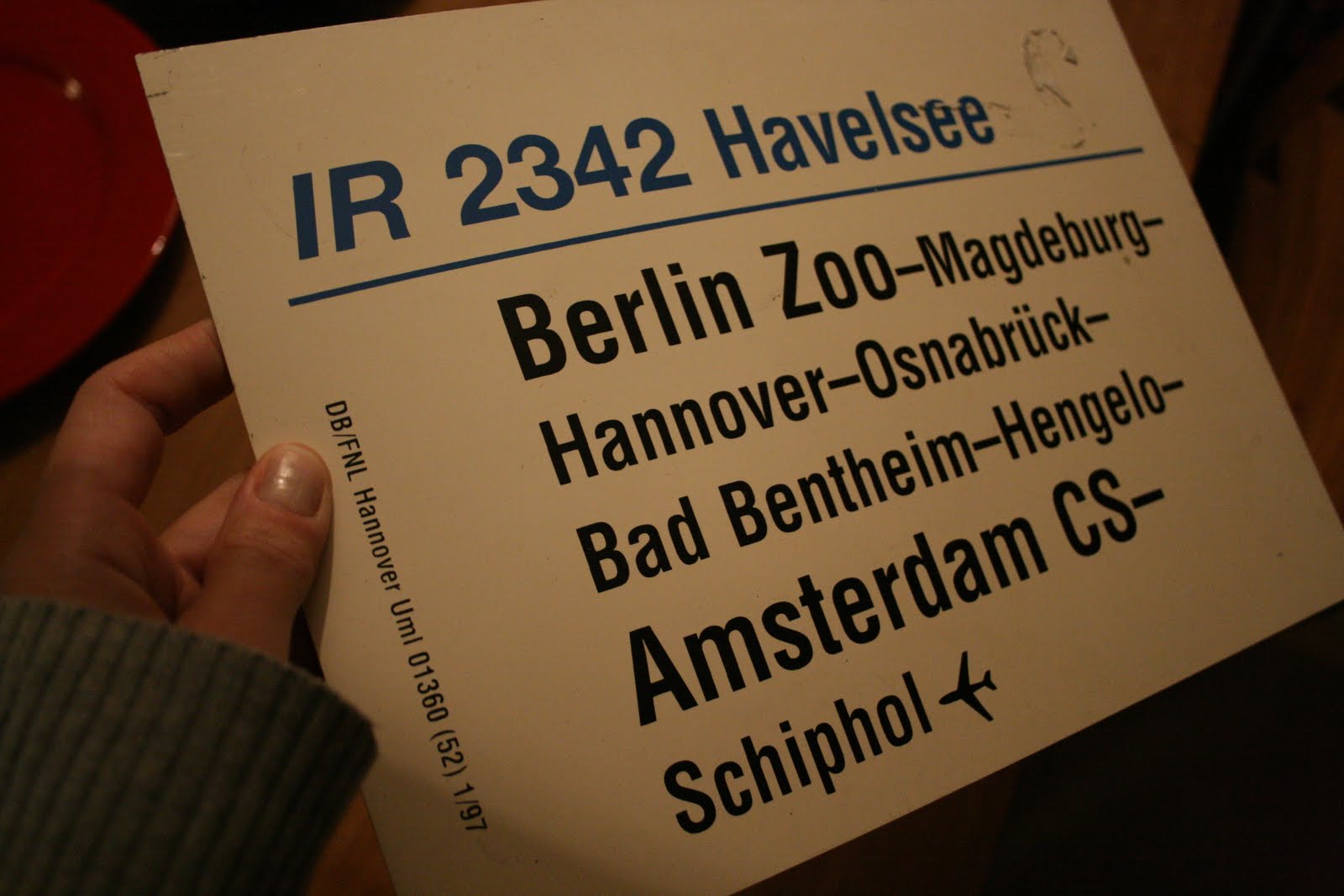
My train—by that I mean the IC between Amsterdam and Berlin Hbf.
Back when the world didn’t have the internet yet and letters within Europe reached their destination three times faster than they do now, back when I hadn’t even seen a cell phone and still went through life writing letters, back when my friend J. and I were waiting for each other, in love, on freezing-cold platforms, several times a year, with clammy hands and no guarantee whatsoever that the other person would actually get off the train—back then, my train was still called the IR (Interregio).
It stops in Amersfoort, in Hengelo, in Osnabrück, in Hanover. And then it stops in Berlin. That one, in other words.
For several years now, that train has been called the IC (Intercity). It’s gotten slower over the years. It’s more crowded. And it stops at more stations than I was used to. But okay, it was still there.
But today, it’s gone.
Deutsche Bahn has a new winter schedule. And starting today, you can book tickets online. But not for that one direct connection between Amsterdam and Berlin—without a transfer.
I pick up the phone. I call Ms. Customer Service. She explains to me: “Yes, of course, ma’am. It’s perfectly possible that trains no longer exist after the new schedule is implemented. Yes, indeed. Yes, that really is possible.” The fact that we’re talking about an international train that runs every two hours—and has done so for at least 16 years—and for which no other route is conceivable, doesn’t faze Ms. Customer Service. It does me, though. I count to ten, but I’m about to lose my temper.
I try again through Mr. Customer Service, am immediately transferred to a friendly lady in Berlin who, unfortunately, “can’t help me either.” And I search the internet to see if I can find a single mention of my missing train. Nothing.
One more try, then. The NS. International Trains Department.
“There are 8 people ahead of you.”
I give up. I type in the company’s address. I click on “Press” and call the spokesperson.
“I’ve tried. I’ve spent 45 minutes on my own time trying to find my train. But I’ve lost it. And I’m also a journalist. So here’s the thing: can you tell me where it went?”
“Yes, I can,” replies a particularly delighted press officer (his name is Holger Auferkamp, in case you ever need him again)
.”“The train isn’t listed in the schedule yet. It’ll all be finalized in two days, and then you can just book it again.”
My train is back! It was never gone! Just virtually! For a very brief moment. I’d love to give Mr. Auferkamp a hug—I’m that happy! I knew it! This couldn’t be happening! Relieved, I ask if they could please post that information somewhere on their website. And if they could also pass it on to Ms. Customer Service in particular, who tried to brush me off so unprofessionally. Mr. Auferkamp agrees with me completely.
On November 4, I’ll be the first to try booking my old, familiar train again right away. This time it’ll work out. And if that’s not the case for you: call Mr. Auferkamp!

Tsja, ik gooi niet zo gauw in de strijd dat ik journalist ben, maar de keren dat ik het deed, werkte het meteen!