So now we have to start thinking about it. Because where are we ultimately going to live in a city with 3.5 million people?
There’s a huge selection.
We could check out the trendy and well-known neighborhoods that are all over Lonely
Planet. Mitte, Prenzlauer Berg, Kreuzberg.
Or the neighborhoods that come right after them on the list and, according to the experts, “are on
the rise.” Neukölln, Pankow, or even Wedding.
My time in Berlin began when I was five, in a cold two-room apartment
in Lichtenberg. The coal stove (we’re talking about 1985), for which my father
had to fetch black briquettes from the basement every morning, was the reason we
moved to Berlin Marzahn a year later.
On the eastern edge of the city, our socialist leaders
had plopped down new housing blocks made of large concrete slabs, complete with hot water and central
heating. We were happy to move in there.
As a child, I thought it was great there—now, for some
reason, “that slab” is no longer an option. (Even though the housing authorities would love for
people like us to move in. They try to lure new tenants with a
year’s worth of free diapers, for example.)
But what, then?
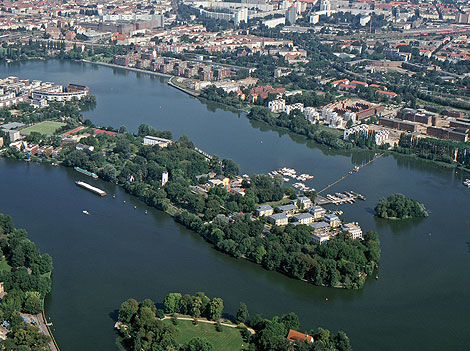
We took a good look around the little neighborhood where my parents live. It’s only a few years old, built by Dutch companies in the Dutch style. Row houses with gardens,
apartments with spacious rooms, and parks and water right outside the door. That’s rare in Berlin.
No, it’s not trendy. No, we wouldn’t be living above a famous club. No, no hordes of tourists. Not a single one, in fact. Instead, a quiet, car-free oasis with a village-like atmosphere and lots of children.
And yet: just five S-Bahn stops from Alexanderplatz, with boats right outside and
a view of the TV tower. Right next door is a former prison where
Erich Honecker was once held. So it’s a little hip after all.
And with my parents within walking distance, so Max can
play in their yard at any time if the balcony gets too small.
Actually, it’s ideal. We should go for it.
The first step has been taken, the first decision made. Now for the next part: German
bureaucracy.
The first stack of forms is ready to be filled out.
