
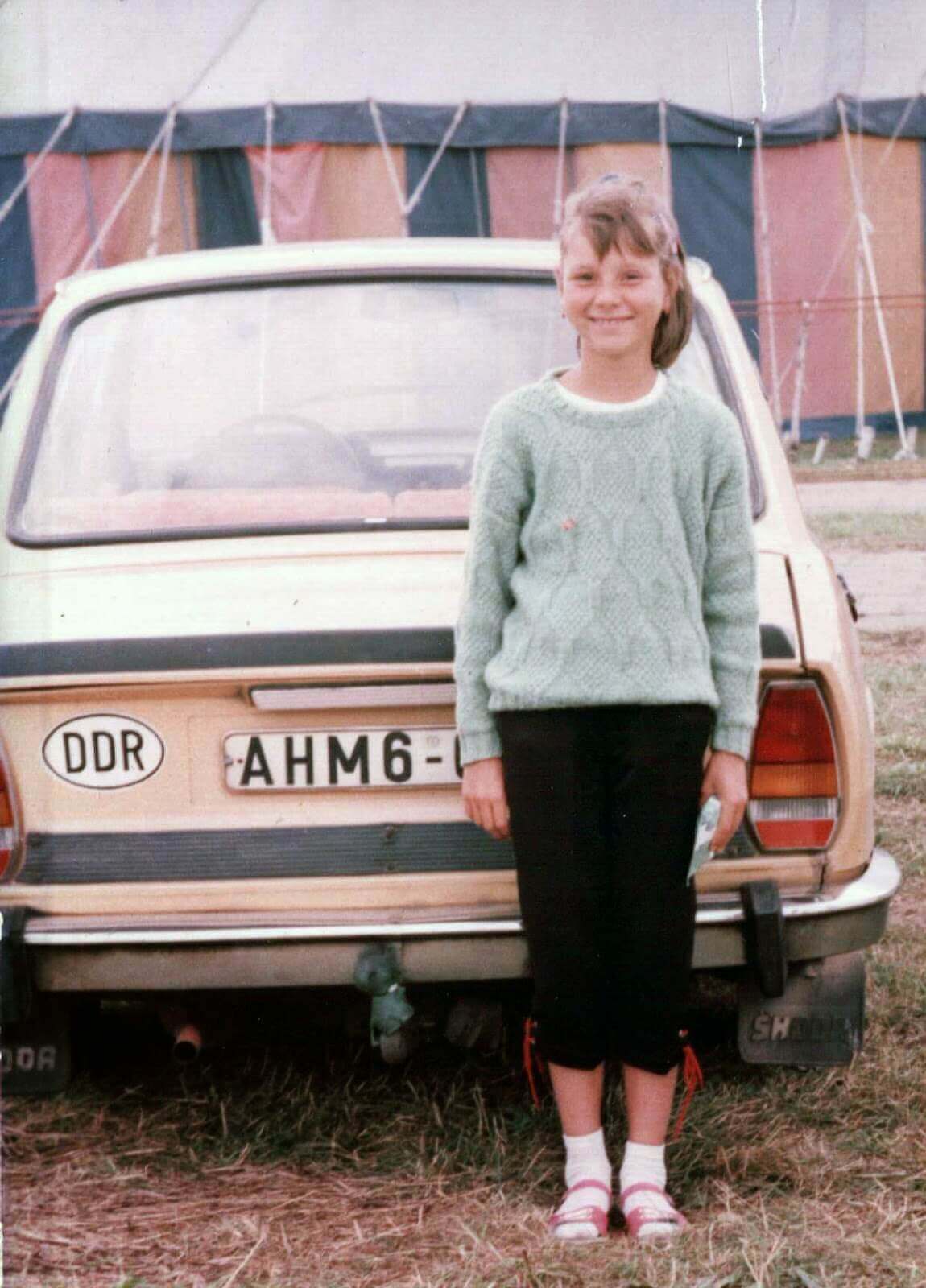
I was 10 when the Wall came down. I moved to Berlin in 1984, when I was 5. I was born on the Baltic Sea, in Greifswald, where my parents were studying. At the time, many East Germans from all over the country were moving to the capital of the GDR; my mother was from the north, my father from the south. Berlin was already the place to be back then if you wanted a good job, so we moved into a two-room apartment with a coal stove.
I remember that it was always cold and that my father had to go down to the basement every morning to fetch coal. My parents quickly grew tired of that, so in the mid-1980s they seized the opportunity to move into one of the brand-new Plattenbauten in Marzahn. Central heating and instant hot water without a water heater—everyone wanted that, so we lived there for a total of nine years, at first still surrounded by mountains of sand, along with many other young families. I stayed in Berlin until I was 19 and attended high school in the Lichtenberg neighborhood; after that, I wanted to see the “big wide world,” and that took me to the Netherlands.
What’s your first memory of the Berlin Wall?
Marzahn is far from the city center. We also lived on the outskirts of Marzahn, in Ahrensfelde, right where the city ends. It takes about 45 minutes to get to downtown. For a very long time, I had absolutely no idea there was a wall. I don’t remember them ever mentioning anything about it at school, and I didn’t hear anything about it from my parents either. I was used to taking the S-Bahn even as a small child to go to my mother’s workplace. She worked near Friedrichstrasse, close to the border. You had to walk a really long way to get to her workplace, but after the Wende, it became easier. If you got off one
stop further (Lehrter Stadtbahnhof back then, now Hauptbahnhof), the walk to her work turned out to be much shorter. But having to walk that far—well, that had to do with the Wall.
Before the Wall fell, I never actually saw it myself. My first memory of it dates back to February 1990. That’s when we went with the family specifically to see the Wall and take pictures. We walked from the Brandenburg Gate to the Reichstag, and I remember thinking it was absurd how close those two buildings were to each other—that the line, and thus the Wall, between them was so incredibly narrow. And that now you could just walk over to the other side. Even though I hadn’t had a clue about the Wall before—I’d never seen it—I did realize that things were now very different from before. That before, there were a lot of things you couldn’t do and, above all, a lot of things you couldn’t buy. There are also some photos from that visit in early 1990—not many, because my parents didn’t feel the slightest urge to just start chipping away at that thing. “Wall woodpeckers”—they didn’t like that at all. They were just glad it was going away, but standing among the crowd and chipping away at it themselves—they didn’t do that.
Have you ever crossed a border—how did that feel?
As a child, I never went to West Berlin or West Germany. Even though we had family living there. I know my mother was once invited to a birthday party near Beckum, and once her application was approved, she went on her own. My father and I
just stayed home. Even though I was pretty young, I was definitely aware that she was crossing a border and going to another country where we couldn’t just go. Why was that? Because of the toys. In the late ’80s, we had West German
TV channels, and thanks to the commercials, all the kids knew exactly what kinds of toys were available. And yes, those were much more colorful and exciting than what was available here. I wanted nothing more than a Barbie, partly because one of my best friends had her
whole room filled with Western toys—her grandparents lived in Austria and regularly sent her packages. She had the Western version of Pippi Longstocking (those are still the blue books in Germany), while I had the abridged white East German version. She had Barbies and stuffed animals with little backpacks that you could turn inside out, so they’d disappear into their own bags. In bright pink, blue, and green. I was also familiar with those items from Intershop, a store where you could buy West German goods, but you had to exchange your money first. My great-grandmother would sometimes take me there, and it was a
paradise. It smelled absolutely wonderful—like coffee and Haribo—and there were Monchichis; so exotic. I wanted it all. In the end, my mom brought me a Steffi, a knockoff Barbie, which I was actually a little disappointed about at first. She did have a dress that glowed in the dark, though, and I thought that was really cool.
The first border crossing I went through on my own was on November 11, 1989, two days after the Wall came down. I went with my dad and my great-grandmother, on our way to visit her two sisters in West Berlin. I think it was the Invalidenstrasse border crossing. I think we were on foot, and it all went very smoothly: we were allowed to pass after showing our
passports. I didn’t feel much at the time, but I was definitely aware that this was something special—that we were now entering a world that was completely unknown to us.
How did the Berlin Wall influence your life?
It wasn’t so much the Wall itself, but life in East Germany that led me to grow up with the norms and values of socialism. As schoolchildren, we were taught certain rules: love for your parents, daily personal hygiene, doing your best in sports, and always doing your very best in school—these were things you didn’t just learn at home, but that the state literally influenced. I became a Jungpionier and a Thälmannpionier (youth organizations that were practically impossible to avoid and were primarily symbolic in nature), and I strove to have my report card presented in front of the entire school. I was a high achiever; and that was exactly what the state drummed into you—how you were supposed to be. I was an exemplary student; I was awarded pins for “Good Socialist Learning at School,” and I was proud of that. What it all really meant—of course
, I didn’t realize that at that age.
For our family, it was simply a given that we lived in this country
. We didn’t know any different. My great-grandmother fled with my grandmother after
the war from what was then Germany and is now Poland (Pomerania)
, and everything the GDR had to offer was an unprecedented luxury for them.
Hot water, nice homes, washing machines, plenty to eat—things that made life
much easier than it had ever been before.
Everyone had a job; everything was well organized. We barely felt the dark side
of the dictatorship. My parents did, though; they were 30 when
the Wall fell, and they could see coming that the state wouldn’t be able to hold on much
longer. The economy was in ruins, the politicians’ arguments were
nothing but a facade—and they sensed that unerringly. Yet this
state was our home.
Two of my great-grandmother’s sisters had ended up on the
Western side by chance after the war—simply because they’d traveled just a little farther. I’ve always found that
a strange sensation. We did stay in touch, mostly
through postcards or the occasional phone call. And from some of our cousins
, we received hand-me-down polo shirts and sweaters, which were more colorful than our own
clothes. But I never noticed anyone being particularly sad that the
rest of the family was living somewhere else. That’s just how it was, so yeah. I have a
pretty pragmatic family. They just accepted it. After the Wall
came down, the sisters had more contact with each other again, but you
could tell it wasn’t always wholehearted. My great-grandmother always said
that all they talked about over there was money and that they couldn’t even bake their own
cakes—they just took them out of the freezer. And she thought that
was awful. After 40
years, there was little common ground left.
Of course, I grew up in that “new Germany”
starting in 1989 and, nine years later, in the Netherlands. In that sense,
I’ve become quite “Westernized.” Looking back, I’m glad I didn’t have to live in the GDR as
a teenager—I think I would certainly have noticed
then that there was all sorts of things wrong with that country. But that meant I
had a sheltered and very independent childhood, during which I
could do my own thing in the city, had my own key
as early as age 6, and made my own pancakes because both my parents worked.
Very modern, actually.
How did you experience the fall of the Berlin Wall?
On the night the Wall actually “fell,” I was sound asleep. We lived far
from the city center; my father had been playing cards with friends that evening, had had a few
drinks, and was already fast asleep. My mother was the only one still awake
and saw the news. She tried to wake my father up,
but he just kept snoring. They didn’t make any move to go into the city center so late at
night.
So when we crossed the
border for the first time on November 11 at Invalidenstrasse, my mother wasn’t with us. She had studied Icelandic
and had been trying for years to travel to that country. Just
before the Wall fell, she finally got her visa, and her flight was on
November 10! That was quite a coincidence, and she was even received by the
Icelandic president because she was the first East German to travel to Iceland after
the fall of the Wall. So there were three of us—
my father, my great-grandmother, and me—and we went to pick up our Begrüßungsgeld
and visit our relatives. I think that was near
Kurfürstendamm. We stood in line for a while until we got the money
, and then our family picked us up. I don’t remember much
else about it, but one of the first things one of my great-aunts did
was drag me to a McDonald’s. She walked over to
the straws, grabbed a whole stack, and pressed them into my hand. “You can take these for free
here!” And I was definitely impressed. Not because they were free
(after all, food and things like that cost very
little back home), but because the straws were so thick. I’d only ever seen really
thin straws that we also used to blow bubbles, since
bubble bottles didn’t exist back then. You’d often end up swallowing a little
soapy water if you sucked it up too far—it was really gross.
We saw store windows with chocolate Santas, as tall as a meter. And we
bought a Barbie. A real one. That was actually my highlight after the
fall of the Wall. I cherished and doted on that doll and played with her a lot
; my mother even sewed clothes for her herself. And she remained
my only one—that’s how special she was.
And after that? Once the Wall had been down for a while? For me, the world
changed only very gradually. Fortunately, my mother kept her job,
but my father didn’t; he started working as a sales representative for West German
companies, and that went in fits and starts over the following years. We started receiving
the new currency, and I started high school right at the moment when
West German children were also making the transition from elementary school to the next
level. Everyone bought a VCR, and video rental stores sprang up in the empty
parking lots of Marzahn. With porn movies on the
top shelf—I can still picture it clearly. I just grew up with
that new country; it didn’t feel like an abrupt transition to me.
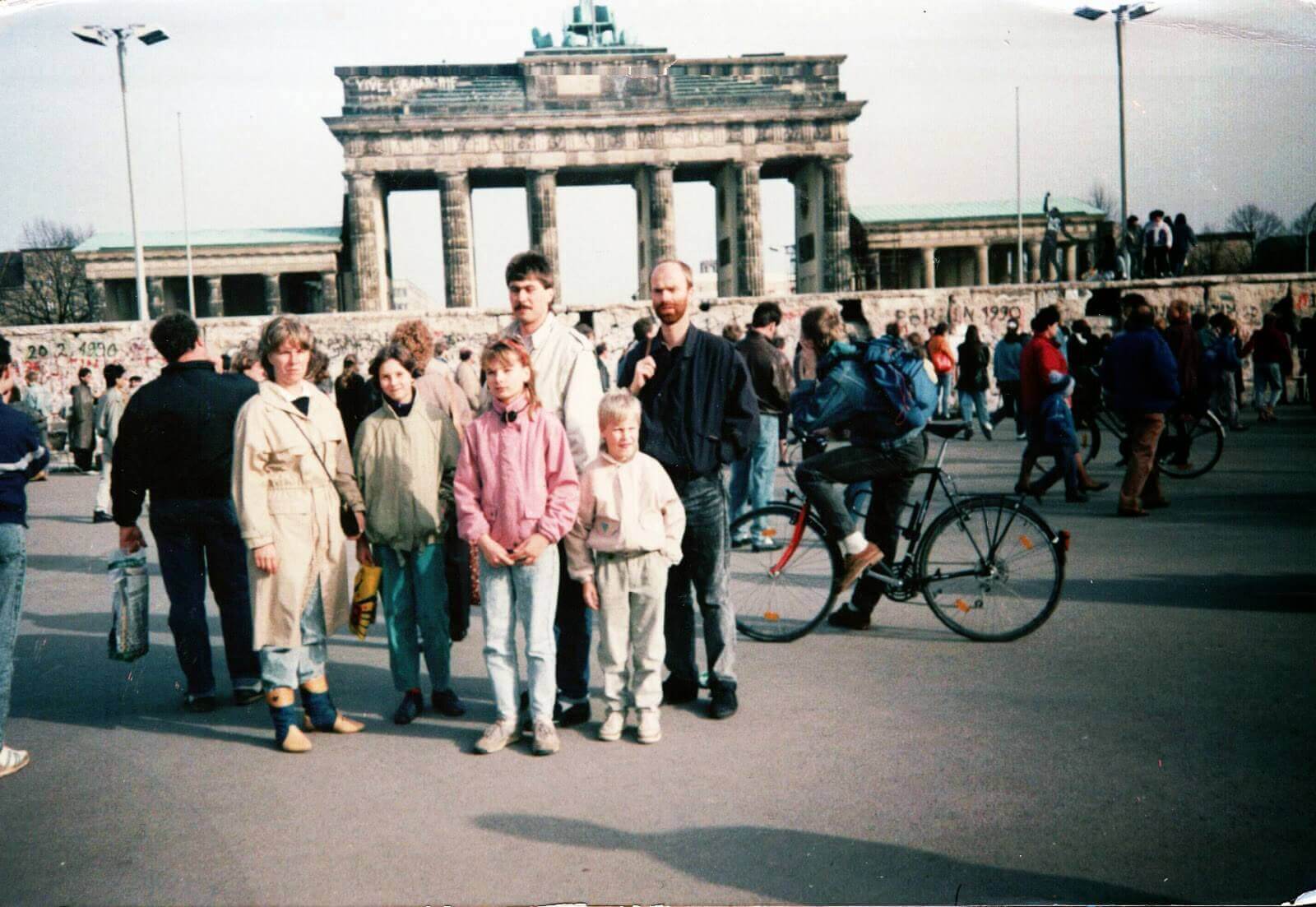
(In the photo, I’m second from the left, wearing turquoise pants and holding a Walkman in the yellow plastic bag, together with my aunt, uncle, cousin, and niece, and on the right is my father)
How do you think Berlin has changed since the Berlin Wall fell?
Enormously. East Berlin was gray and quiet. At least, that’s the impression I have. Cold
apartments, lots of coal stoves, few cozy shops. Of course, I don’t have all those
memories in my head, but when I see photos from that time now
, the change is enormous. Marzahn was
ugly with all the concrete slabs and dirt and sand everywhere. Back then, of course, they were
just starting to plant the first trees; now it’s one of the
greenest neighborhoods. As a kid, I didn’t notice that, though; we had the time
of our lives there. All the parents worked full-time, so we’d go out in
little groups. We’d climb the sand dunes, crawl through the concrete
pipes lying all over the place, walk into the supermarket (Kaufhalle), and buy
lollipops for 5 Pfennig. Or a sandwich. That only cost 5 Pfennig, too. We
collected old paper and glass bottles by ringing people’s doorbells. They’d
give us everything, and we’d turn it in and save the
money in a piggy bank in our classroom.
None of those things exist anymore. These
days, you rarely see six-year-olds scrambling through Berlin on their own; there are only a few coal stoves left
, and the city has become bustling. Of course
, I’d already said goodbye to Berlin once back in 1998, and from the Netherlands I was able to see even more
clearly how much everything was changing. Every time I visited my
parents, there was a new massive construction site. Potsdamer Platz.
The Hauptbahnhof. The government buildings next to the Reichstag. A Brandenburg Gate that was suddenly
gleaming white instead of the old gray one I
was used to. The city has become much more international, especially over
the past ten years. I still prefer the eastern
part. That’s where the old buildings are, and that’s where nice, trendy
little shops have popped up—for example, in Friedrichshain, where there used to be only
residential buildings, but no stores. Now you can browse through
bookstores, clothing boutiques, and fabric shops, have lunch, and drink coffee
. Or Russian tea. Or Moroccan tea. Or a chai latte. You name it
—you can find it here. After just five steps, you’re already standing
in front of the next café. In West Berlin, I still sometimes get a sense of what
it must have been like back then—a certain idyll, a little
world of its own that only West Berliners shared among themselves. That feeling
comes over me when I see
an elderly lady sitting in a café in Charlottenburg. Still, I remain an East Berlin girl. The city has become much
more dynamic, lively. Day and night. And yet it has managed to retain a certain
tranquility and sense of space. Hopefully, that will be preserved at least a little in the years to come
. But I think it’s true what Karl
Scheffler once said: “Berlin ist dazu verdammt, immerfort zu werden und
niemals zu sein.”
(Written at the initiative of Marjolein van der Kolk, from berlijnblog.nl)
