“Boo,” I say as I walk in through the heavy wooden door. Seven faces stare at me in bewilderment from the seminary living room. One of them belongs to my former colleague Michael. “We’re actually in the middle of a moment of reflection.”
In contemplation, in contemplation… What on earth is that supposed to mean, I wonder. And I realize that, with my three bags and my good intentions, I’ve walked in a little too early. I’d been promised a beer—a nightcap after four days of work. But a quarter past nine is too early. “It’ll take until about a quarter to ten; I’ll let you know when we’re done.”
I head to my little room where I’ve slept for the past three nights. I unpack the camera again and connect it to my laptop to upload the footage I shot today.

It’s Monday. I moved in here with my things on Thursday evening. Four days, fourteen interviews. Three appointments a day. Not to mention the countless celebrations, Masses, and prayers.
I’ve ended up in a world that’s foreign to me.
I’m not really into the church. Until I was 20, I didn’t even really know what it was all about. In East Germany, it wasn’t promoted, and at the schools I attended and in the neighborhoods where I lived, I didn’t know anyone who was religious. On vacation, I’d walk in, but I had no idea what the people there were doing on their knees—I just thought the centuries-old buildings were really beautiful.
That is, until I came to the Netherlands, met my first roommate in Groningen, and she told me she went to church every Sunday. That she took catechism classes (I still have to look it up to know what it is) and that the values and norms I, too, lived by were actually derived from the Bible and the Christian faith. Is the history of our entire Western society intertwined with the Christian faith? I couldn’t remember seeing such things in my history books and found it all rather strange.
Over the years, I got used to the fact that there were many more Dutch people who believed in God. I had just as many non-believing friends, but at least I was now aware of their existence, and I’d also come to realize that the others weren’t really that crazy—it was just that there was a huge gap in my cultural education. I’d occasionally attend church for a wedding or a funeral; I had a friend who’d once been “away from God” but had returned to a church community, and I found it all a bit more normal than before.

Last December, I suddenly received a message from my former colleague Michael. I’d worked with him in journalism for six years. A few years ago, he announced to the editorial staff that he was going to make a rather unusual career change. He wanted to become a priest. An unusual choice for a journalist. At least, that’s what all his colleagues thought.
He enrolled in a part-time program and was now studying twice a month, tucked away somewhere in Breda. We didn’t know exactly what he was doing there, but we did know it wasn’t a joke and that he already knew exactly when he would resign from his job to complete the final two years of his training there. Last summer, the time had come.
This winter, he messaged me asking if I’d come to Bovendonk to shoot some videos. Portraits, interviews, and reports for a website run by the Diocese. About vocations. Why God calls people and how one should respond to that call.
He knew I don’t care much for that kind of language. That I’m a fairly staunch atheist who doesn’t believe in God. I felt honored that I, of all people, was asked. And I immediately said “yes.” But precisely because I know so little, I also find it all incredibly interesting. Why are they called by someone? What does that sound like? And why would you want to become a priest? They must all be very different from me if they chose such a path.
The Bovendonk seminary is a small Harry Potter-style castle. The rector (that’s the head of the seminary) wears black, with a little white thing around his neck. Surrounding him are six men, and on the weekend another 15 join them for a study weekend. It makes me quiet. For the first 24 hours, I hold myself back a lot. I speak more softly and less often, nod more, and listen. Almost all of the men radiate a serene calm, and I take that on.
Partly because I want to be careful. How much of myself can I reveal? In a place like this, where prayers set the daily rhythm? Where you’re not supposed to swear—or even laugh out loud?

One by one, I get to know the boys and men in the program. I talk with teachers who simply teach theology. With one of the few women who come here, who is responsible for “personal development”—getting to know yourself. With the bishop of Breda, who seems very stern and unapproachable during the solemn service but turns out to be a really nice, friendly man during the interview.
They’re all smart. They have to be, because to make it here, you need to be able to study at least at the higher vocational education level and plow through very thick books on the history of the various faiths. You’re also turned inside out. Do you really want this? Are you responsible enough? Can you learn to pray regularly? Are you open to others? Can you listen? Can you lead? Are you spiritual enough to live entirely for your faith?
Many of these men are what are called “late callings.” It wasn’t until they were in their 30s or 40s that they realized there had to be more to life than just an ordinary job. I’m talking to a software developer, an ambulance worker, an account manager, and a crane operator. All four work their “old” jobs during the week and attend seminary on the weekends. Two worlds that seem incompatible, but they make it work.
At least—that remains to be seen. Some are happily married and want to serve as deacons. Others have little trouble with celibacy and feel called to become priests. But many men also drop out—either because they find it too difficult or because they fall in love.
Despite their significant differences, they seem to form a close-knit community. Because I get up with them every day, have breakfast, lunch, and dinner with them, and because I’m allowed to ask them very directly about their personal experiences and feelings, I quickly start to feel like one of them. With all my wonder. More and more often, I dare to just blurt out questions. Questions I have myself. How do they keep it up? Why do they get up so incredibly early, and why doesn’t the last shift end until ten o’clock at night? Why are only men allowed to participate? And what do they feel when they talk about God? They answer everything.
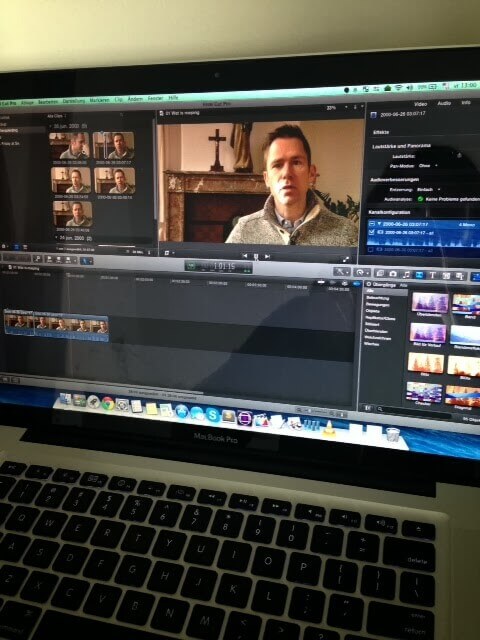
Michael, too. For the first time, I can ask him exactly how it all works. Why he left a radio and television newsroom behind for a new life. He answers. Openly and honestly.
I realize I had certain expectations going in. Quiet men, bent over in prayer. Deeply absorbed in their own faith.
So far, that’s entirely true.
But that they wouldn’t laugh, wouldn’t be able to chat out loud, or would have lost touch with the “ordinary” world—no. They drink beer, they sit together in good company and crack jokes, they sometimes giggle like they did in high school, tease each other, and they can sing beautifully, too. I didn’t see anyone floating ten centimeters above the ground.
Exactly what they believe in—and, above all, what they feel in the process—that’s the line I can’t quite cross. I understand the priests and deacons in training better than I ever thought I would, but to empathize with what that must be like down to my very core—no, I haven’t managed that.
And maybe that’s for the best; a journalist always keeps a little distance.

Boeiend om te lezen. Juist geweldig om een journalist die weinig heeft met kerk en geloof dit te laten maken. Helemaal goed. Veel succes verder!
Greet Kappers