Journalist | Editor | Chairperson | Germany expert / correspondent | in Hilversum & Berlin
On Radio 1: Greater acceptance of “Hochdeutsch.”
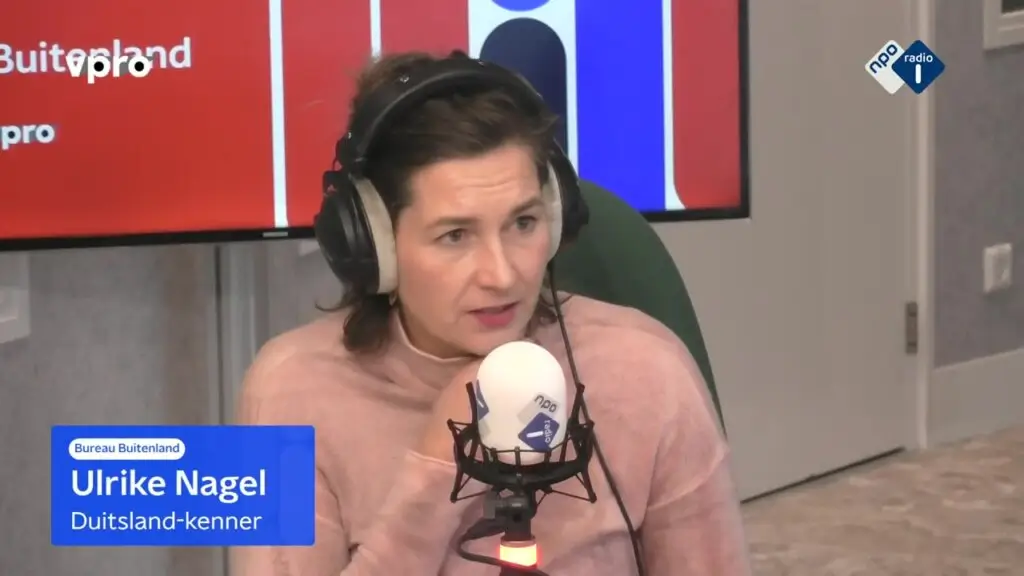
In the “Spotlight” section, we highlight a unique initiative by German linguists who are seeking greater acceptance for “Hochdeutsch.” Journalist and Germanyexpert Ulrike Nagel brings us up to speed on “Bureau Buitenland.” What exactly is “Hochdeutsch”—the German equivalent of Standard Dutch? That’s the question linguists in Bavaria are asking. “They explain that there isn’t just one standard German language at all, but that it varies by region,” says Germany expert Ulrike Nagel on *Bureau Buitenland*.
00:00 Radio 1, Sophie Derkzen 00:31 Ulrike Nagel 01:34 Sophie Derkzen 01:44 Ulrike Nagel
Ulrike Nagel on Radio 1 discussing greater acceptance of Hochdeutsch.
Summary of this conversation
In “Bureau Buitenland” on Radio 1, journalist Ulrike Nagel discusses a debate among linguists in Bavaria regarding the definition and acceptance of Hochdeutsch.
Discussion on High German [00:00]: Linguists in Bavaria argue that there is no single standard High German, but that it varies by region. They want greater acceptance of these regional variants.
Regional Standard Languages [00:44]: In addition to the many dialects in Germany, there are six regional standard languages, of which Northern High German is often considered the most correct version. Nagel, who is from the north, speaks this version herself [01:00].
Bavarian Pride [01:22]: Bavarian linguists argue that Southern High German—spoken, for example, by the Minister-President of Bavaria—should also be recognized as a valid version of High German and that people should be proud of it. They give examples of regional differences in word usage, such as “Buab” (Bavarian) / “Bube” (Southern High German) / “Junge” (Northern High German) for “boy,” and “Semmel” (Southern) / “Brötchen” (Northern) for “roll” [01:38].
Cultural Identity [02:35]: The discussion highlights the desire to preserve and promote their own cultural identity, including through language. They want to educate the country and encourage their own people to take pride in their regional language use.
Background
In Bavaria, Bavarian is spoken. In addition to all the dialects in Germany—which are just as diverse as those in the Netherlands—there is also a standard language for each region. “There are six in total, while for most Germans, High German from the north is generally considered the ‘correct version,’” says Nagel.
In Bavaria, they now want to make it clear that they “have every right to be proud” of their own regional High German.
Here’s how it sounds
Take the word “boy,” for example; it sounds like this: “Bua” in Bavarian, “Bub” in Southern High German, and “Junge” in Northern High German. These are three different words, but none of them is wrong. Another example is “bread roll”; while everyone in Northern High German says “Brötchen,” in the southern part they use “Semmel.”
The German debate is similar in some ways to the Dutch one, Nagel explains. “In the Netherlands, too, the standard language is largely based on Dutch dialects, particularly those of the northern regions. There are also regional variations in Dutch. Although Frisian is a language in its own right, something like that isn’t an issue in Germany.”
In Bavaria, linguists feel that their own standard German is less tolerated and accepted, says the Germany expert. “That’s why they want to inform Germans that regional versions of High German are just as correct as those in the north.”
On “Bureau Buitenland,” you’ll hear international news, reports, and geopolitical analysis. Featuring background stories and noteworthy reports, Monday through Friday from 1:30 to 2:00 p.m. Hosts: Sophie Derkzen and Tim de Wit