Journalist | Editor | Chairperson | Germany expert / correspondent | in Hilversum & Berlin
Minority Government in the Netherlands: Another Experiment
The prospects for the minority government in the Netherlands, announced on Wednesday, are generally good. That is the assessment of journalist Ulrike Nagel. The talks between the coalition partners were constructive.
The social-liberal party D66 has nominated Rob Jetten as prime minister. This marks a first for the party, which won the Dutch elections.
Together with the conservative CDA and the right-wing liberal VDD, they are forming a minority government. This means they will always be dependent on the opposition for a majority. That will be a challenge, says Ulrike Nagel. Even the largest opposition party, the Green PvdA, would be upset about not being part of the coalition.
However, the VVD would have categorically ruled that out.
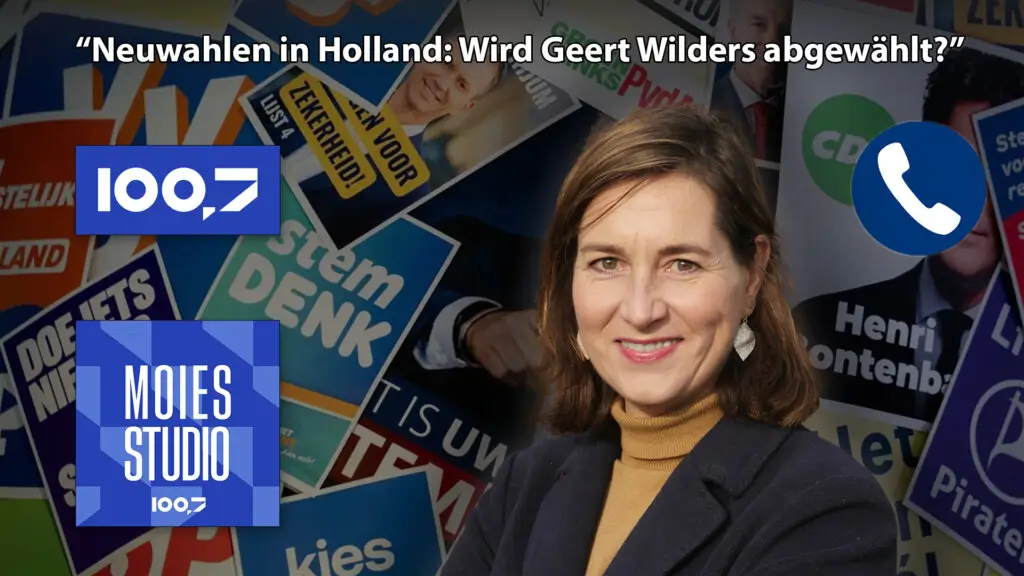
Here is a summary of the interview with journalist Ulrike Nagel on Radio 100.7 on January 29, 2026, about the political situation in the Netherlands:
The New Government and Rob Jetten
A historic moment: Rob Jetten, 38, of the left-liberal D66, is expected to become the youngest prime minister in the history of the Netherlands.
The coalition: It consists of an alliance between D66, the Christian Democrats (CDA), and the right-wing liberals (VVD).
Minority Status: Since the coalition does not have a majority of its own in Parliament, it must rely on votes from the opposition for every legislative initiative.
The Coalition-Formation Process
Speed: The negotiations lasted only about three months (since December), which is unusually fast by Dutch standards.
Constructive work: The parties have already worked through the night to draft a joint budget.
Jetten as a “bridge-builder”: Jetten is described as a likable and positive politician who laid the groundwork for cooperation through a 17-page “guideline” (drafted together with the CDA).
Why a minority government?
VVD veto: A more stable centrist majority coalition failed because the VVD categorically refused to cooperate with the alliance of Social Democrats and Greens (GroenLinks-PvdA).
Opposition: The Social Democrats now form the largest opposition party and are frustrated at not being part of the government.
The Crisis Among Right-Wing Populists (PVV)
Mutiny in Wilders’ Party: Two weeks ago, seven members of parliament left Geert Wilders’ party, criticizing its undemocratic structure (Wilders is the only official member).
Loss of power: As a result, the PVV has shrunk to 19 seats and lost its status as the largest opposition party.
Obstructionist stance: Wilders has already announced that he will not support the minority government’s plans under any circumstances.
Conclusion on the mood
Despite the difficult search for majorities, the current mood is viewed as significantly more constructive and trusting compared to the failed cabinet of 2023.
Stay better informed throughout the day. Interviews, reports, and analysis from the 100.7 Morning Studio. Hosted by Maurice Molitor. Radio 100.7 is a public radio station in the Grand Duchy of Luxembourg. Radio 100.7 broadcasts primarily in the Luxembourgish language. However, some interviews are also broadcast in French and German without translation.