Journalist | Editor | Chairperson | Germany expert / correspondent | in Hilversum & Berlin
On “Goedemorgen Nederland”, a segment on the German state visit to the Netherlands
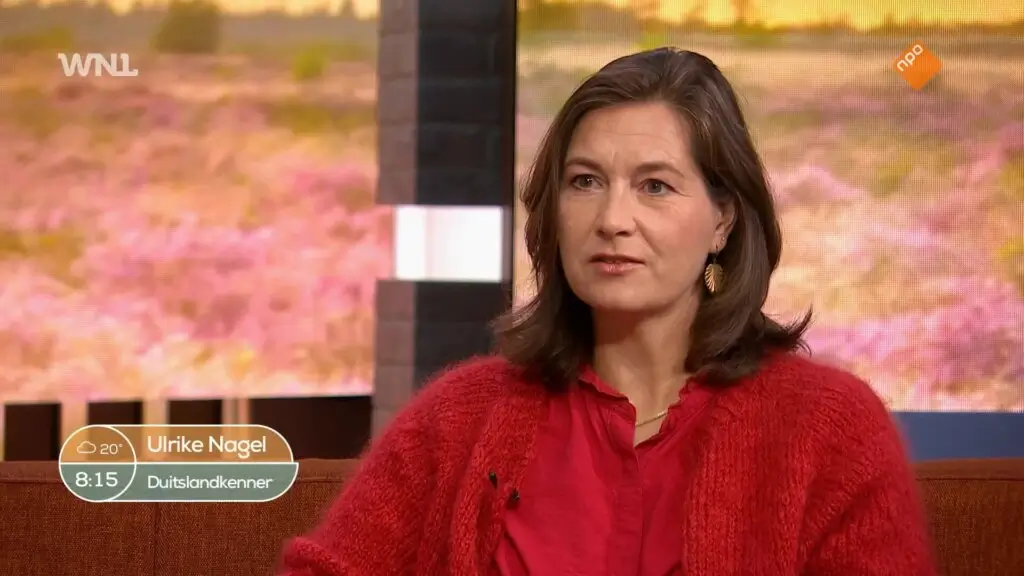
Germany expert Ulrike Nagel on *Goedemorgen Nederland* on WNL, discussing the German state visit to the Netherlands.
In this video from “Goedemorgen Nederland” (WNL), political reporter Ulrike Nagel discusses German Federal President Frank-Walter Steinmeier’s state visit to the Netherlands, as well as the broader political and economic relationship between the two countries.
Ulrike Nagel on “Goedemorgen Nederland” on WNL discussing the German state visit to the Netherlands.
Here are the key points from the discussion:
The State Visit and the Role of the Federal President Ceremonial and symbolic: The Federal President holds the highest office in Germany, but the role is primarily neutral and symbolic [01:39]. This contrasts with the Dutch royal couple, whose popularity in Germany often opens doors for them [01:46]. Farewell Visit: Steinmeier has been Federal President since 2017, and his term ends in March of next year [02:16]. This is his final state visit to the Netherlands [02:23]. Speculation about Angela Merkel’s successor has been categorically denied by Merkel herself [03:50].
Ulrike Nagel on “Goedemorgen Nederland” on WNL discussing the German state visit to the Netherlands.
Schedule of the three-day visit Historical significance: The visit begins in Amsterdam with the laying of a wreath at the National Monument on Dam Square and a visit to the Holocaust Museum [02:44], [03:19]. Jewish and wartime history will always remain an important and emotionally charged aspect of German-Dutch relations [02:56]. Economic focus: On the second and third days, the focus shifts to the economy and trade, with visits to the Port of Rotterdam and chip equipment manufacturer ASML [14:36]. The Political and Economic Relationship Trade Interests: The Netherlands and Germany are each other’s most important trading partners, with an annual trade volume of more than 200 billion euros [05:46]. Political cooling: Under the previous cabinet (Schoof), relations at the government level had cooled somewhat [05:14].
Ulrike Nagel on “Goedemorgen Nederland” on WNL discussing the German state visit to the Netherlands.
Germany (under Chancellor Scholz) found the PVV’s presence in the Dutch cabinet complicated due to its own domestic political dynamics and the “firewall” (cordon sanitaire) against right-wing populist parties such as the AfD [06:30], [06:53]. Minister Rob Jetten has since begun a damage-control effort to mend ties [05:21]. Border regions and culture: Despite political shifts in the capitals, border regions (such as North Rhine-Westphalia) actually enjoy very close, day-to-day cooperation in the areas of public transportation, fire services, and the economy [11:11]. Many Dutch people also travel to Germany because basic goods, drugstore items, and alcohol are generally cheaper there [11:55].