Journalist | Editor | Chairperson | Germany expert / correspondent | in Hilversum & Berlin
On Radio 1’s “Bureau Buitenland”: AfD Officially Designated as Extremist
Major upheaval in German politics: the intelligence agency has labeled the Alternative for Germany (AfD) party as extremist. According to the agency, the party poses a threat to democracy. Could this assessment lead to a ban on the AfD? Wiebke Pittlik of the Germany Institute and journalist Ulrike Nagel discuss the consequences for the AfD and the German political landscape.
AfD Officially Designated as Extremist The German Federal Office for the Protection of the Constitution (Bundesamt für Verfassungsschutz) has officially designated the AfD (Alternative for Germany) as an extremist party and a threat to democracy [00:02]. This means that the AfD, as a federal party, is now under surveillance because “evidence has mounted” that the party is right-wing extremist and directed against the liberal-democratic principles of the Federal Republic of Germany [00:11]. According to the security agency, the party seeks to exclude certain population groups, which is incompatible with a democratic legal order [00:20].
Reaction from Ulrike Nagel and Wiebke Pittlik [00:35] Journalist and Germany expert Ulrike Nagel and Wiebke Pittlik of the Germany Institute discuss the implications of this for the party, which finished as the country’s second-largest party in the February elections and is currently the largest in some polls [00:35].
Nagel: The news comes as no surprise, as it has been expected for some time [00:55]. The review process consists of three steps: first, extremist elements are examined; then the party is declared “suspicious”; and finally, a judge must issue a definitive ruling [01:17]. The latter has now taken place [01:45].
Pittlik: The Security Service submitted a 1,100-page dossier [02:10]. The emphasis is on the party’s ideology, which espouses a conception of the people based on ethnic origin, leading to exclusion and violating human dignity as enshrined in Article 1 of the Constitution [02:17]. They examined statements by leading politicians, the party platform, and connections to far-right extremist groups [02:38]. They also took into account the fact that the AfD has incorporated its youth wing—which had previously been classified as far-right—as well as the party’s behavior during election campaigns [03:01].
Radicalization of the AfD [03:23] According to Pittlik, the AfD has become increasingly radicalized in recent years [03:23]. A clear radicalization was particularly evident in the past year, during the elections. The party did not seem afraid of the Security Service’s impending assessment and made outright racist statements [03:32].
Legal: From a legal standpoint, not much will change initially [04:04].
Politically: Politically speaking, tensions will rise and parties will respond [04:12]. Previous attempts have been made to ban the party, but this is a very meticulous and risky process in Germany, so it is not a course of action that is easily taken [04:25]. In January, there was insufficient support in the Bundestag for an attempt to ban the party [04:30]. The 1,100-page document containing evidence could now serve as a basis, but political parties remain cautious, especially since the AfD is polling high [04:49].
Role of the Constitutional Court: Ultimately, the Constitutional Court will decide on a possible ban, not the Bundestag or the government [05:38]. Pitlik believes that a new attempt to ban the party has become more likely, but continues to emphasize that it is complicated, partly due to a previous failed attempt involving the neo-Nazi party NPD [05:56]. A failed ban could actually reinforce the AfD’s claim to be a democratic party [06:34].
Reaction from the AfD and Concerns About East Germany [06:56] The AfD has reacted furiously. Party Chair Alice Weidel called it an “attack on democracy” and will do everything in her power to stop it [06:56]. Nagel understands this reaction, given the party’s large support base [07:08]. However, Nagel is deeply concerned about how people in former East Germany—where 40–50% voted for the AfD—will react to this [07:48]. They will see this as a provocation and will be difficult to convince. The fact that the report is not being made public will further fuel their skepticism [08:11]. Ulrike Nagel wonders how established politicians, such as Merz, will reach these people [08:34].
Challenges for Friedrich Merz and the new government [08:46] Wiebke Pittlik points to a recent discussion within the CDU about a “more normal” approach to the AfD, for example by giving them chair positions on Bundestag committees [09:04]. This discussion will likely be reversed now, as the Security Service has made it clear that the AfD is “not a normal party,” but a “racist, far-right party” [09:40]. Merz will have to address this, and the discussion on this topic will undoubtedly continue in the coming days [09:58].
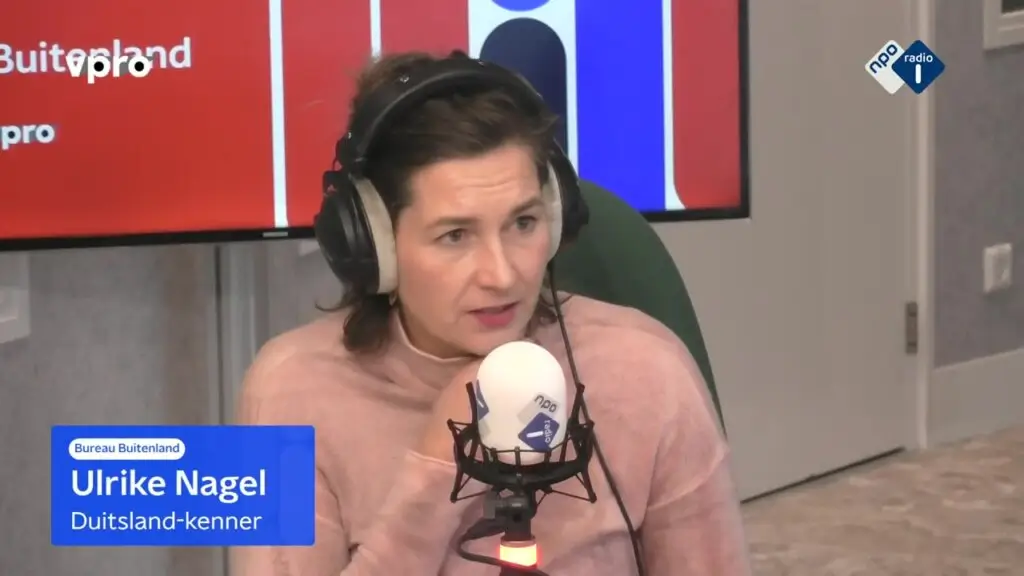
Ulrike Nagel in the Radio-1 Studio
Background
The German intelligence service has labeled Alternative für Deutschland (AfD) as far-right extremist. The party is said to pose a threat to democracy.
The new designation means that German authorities will have greater powers to monitor the party. For example, the intelligence service is now permitted to recruit informants. The party will not be banned.
The AfD has been considered controversial for years. Until now, it was characterized as “potentially far-right,” but according to the German intelligence service, there is no longer any doubt that the party as a whole is far-right.
According to the German intelligence service, “the ethnic-based views prevalent within the party are incompatible with the free democratic basic order.” The AfD is said to aim “to exclude certain population groups from equal participation in society, in order to subject them to unconstitutional unequal treatment.”
The AfD is waging a well-established campaign against the free democratic order, Interior Minister Nancy Faeser said Friday. “The AfD represents an ethnic concept that discriminates against entire population groups and treats citizens with a migration background as second-class Germans,” Faeser said in a statement. “Their ethnic stance is reflected in racist statements, especially against immigrants and Muslims.”
The AfD’s party leaders are calling the decision a “severe blow to German democracy.” They reject the label and describe it as a politically motivated decision.
“The AfD is being publicly discredited and criminalized shortly before the change in government,” reads a statement from leaders Alice Weidel and Tino Chrupalla. They assert that the party will continue to defend itself legally against “these defamatory statements.”
The debate over banning the AfD flared up intensely last year after a German investigative group revealed that leaders from German and Austrian far-right circles had gathered at a hotel in Potsdam.
One of the prominent speakers, the Austrian Martin Sellner, is said to have advocated there for a “remigration master plan.” Under this plan, refugees and German citizens with an immigrant background would be forced to leave the country.
Discussions reportedly took place regarding deporting them to an unnamed nation in North Africa. Tens of thousands of residents in cities such as Cologne, Essen, Leipzig, and Berlin subsequently took to the streets en masse.
On “Bureau Buitenland,” you’ll hear international news, reports, and geopolitical analysis. Featuring background information and remarkable stories, Monday through Friday from 1:30 to 2:00 p.m. Hosts: Sophie Derkzen and Tim de Wit