Journalist | Editor | Chairperson | Germany expert / correspondent | in Hilversum & Berlin
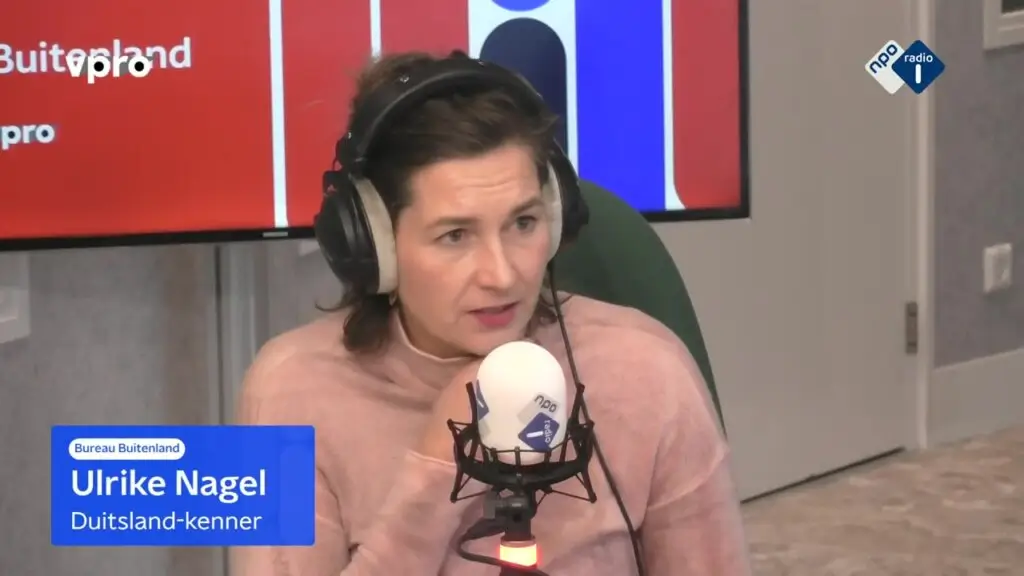
NOS Radio 1: Ulrike Nagel grew up in East Germany
Saturday, October 3, marks the 30th anniversary of the reunification of East and West Germany. The Berlin Wall had fallen the year before, which was, of course, a significant moment in Germany’s recent history. In the broadcast, journalist Ulrike Nagel talks about life in East Germany, where she grew up. Listen to the interview with Jurgen van den Berg.
Summary of the conversation ↴
On NPO Radio 1, journalist Ulrike Nagel discusses German reunification—30 years after the fall of the Wall—and the question of whether the country has truly become one.
Childhood in the GDR and Awareness of a Different Germany
Ulrike Nagel was born in Greifswald, a university town with a nuclear power plant nearby [00:35]. She describes Greifswald as a beautiful old city with a mix of fortifications and Plattenbau. Her parents were young when she was born and later moved to East Berlin, first to a two-room apartment without central heating or hot water, and then to a newly built apartment in Marzahn that had these amenities [01:08].
As a child, Nagel was always aware of a different Germany, especially through toys and clothing [02:48]. Her friends had Barbies and West German stuffed animals, and Nagel herself received secondhand clothes in bright colors sent to her by family in West Germany. She also remembers surprise eggs containing a seesaw that didn’t work with East German currency [03:58].
The Fall of the Wall and First Steps in the West
Nagel, who was 10 years old when the Wall fell, remembers most vividly her mother’s trip to Iceland on November 11, 1989. She herself went with her father and great-grandmother to West Berlin, to the Kurfürstendamm. There, they received free money from the bank, with which Nagel bought her first (and only) Barbie. She also remembers “grabbing” as many thick straws as she wanted for free at McDonald’s—something that would have been unthinkable in East Germany [05:09].
Is Germany Truly Reunited?
According to a recent poll, 23% of Germans believe the country has not yet become one, mainly due to differences in living conditions [00:11].
Economic Inequality: A West German household has twice as much wealth as an East German household. Pensions and salaries have not yet been equalized; in East Germany, you still earn less for the same work [07:16].
“Wessis” and “Ossis”: There was a sense of “annexation” rather than reunification, with West Germany holding the upper hand and “Wessis” (West Germans) bossing around “Ossis” (East Germans). The value of the East German way of life disappeared.
Personal Benefit: Many East Germans (nearly half) report having personally benefited from reunification.
Self-Confidence: Over the past 10 years, East Germans have developed their own sense of self-confidence and have become more assertive. No one can ignore the East anymore.
Ulrike Nagel emphasizes that Germans within the country itself already differ enormously, regardless of the East-West divide. She argues that there is more unity than ever, and the majority is happy with that unity, even though differences still exist [06:35].
Background ↴
It has been nearly thirty years since East and West Germany were reunified. Yet demographic trends between the two regions today are very pronounced. And it does not appear that this will change, according to a new study by the Berlin Institute for Population and Development.
On October 3, 1990, the German Democratic Republic (the GDR, or East Germany) was reunified with West Germany. Since then, Germany’s population has grown by approximately 3.4 million people. By the end of 2019, the total population of Germany stood at no fewer than 83.2 million.
The German reunification of 1990 into a single Germany brought an end to the period of division between the former GDR, the German Democratic Republic (East Germany), and the FRG, the Federal Republic of Germany (West Germany).
However, the differences between East and West remain significant. While the western states saw an increase of nearly 5.5 million people between 1990 and 2019, the five eastern states (Brandenburg, Mecklenburg-Western Pomerania, Saxony, Saxony-Anhalt, and Thuringia) saw their populations decline by more than 2 million people. Saxony-Anhalt (the state west of Berlin) in particular experienced a sharp exodus. There, the population has shrunk by a quarter over the course of thirty years.
The cover of the *Jahresbericht zum Stand der deutschen Einheit* (Annual Report on the State of German Unity) features the facade of a house in the East German city of Görlitz. On the left is how it looked in the 1980s: old and dilapidated, a ruin. On the right, the news site tagesschau describes how the house looks today, restored to a showpiece. This is how the federal government likes to portray the situation in East Germany 30 years after reunification.
Read the full Annual Report on the State of German Unity (2020) here as a PDF (12 MB).
Much has been achieved, according to the annual report on the state of German unity. It was presented on Wednesday by Marco Wanderwitz (CDU), shortly before the celebration of the 30th anniversary of German reunification on October 3. He is the Ostbeauftragte, the federal government’s special representative for East Germany. “Some things have taken a little longer than planned. But in many areas, we can essentially say: unity accomplished, unity restored, unity achieved.”
The study reports that migration from East to West has virtually stopped since 2015. However, due to the exodus in the 1990s, too few children were born to restore the population to its previous level. Nor has migration from abroad been able to fill that gap.
East Germans fought for democracy in 1989 and 1990, but after that, their right to have a say and participate in decision-making quickly came to an end. Since reunification on October 3, 1990, West German political, economic, and social systems have also applied to East Germany. Many East Germans feel that these systems were “imposed” on them and consider themselves second-class citizens. This was confirmed again earlier this month by a study from the German think tank Bertelsmann Stiftung. About 60 percent of the East German participants surveyed indicated that they feel like second-class citizens. West Germans feel this way much less often. For East Germans, the fact that they come from East Germany is still very important to their identity, while West Germans view their origins as less relevant.