Journalist | Editor | Chairperson | Germany expert / correspondent | in Hilversum & Berlin
On BNR Nieuwsradio: Elections in Germany
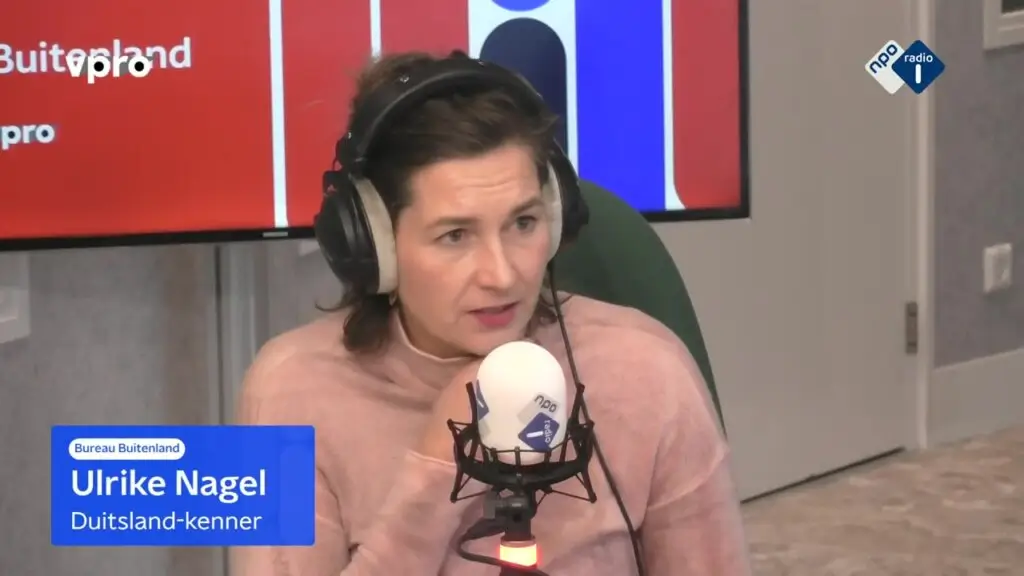
Ulrike in conversation with Derk Marseille on BNR Nieuwsradio during the program “The Daily Move” about the current state of affairs regarding the elections in Germany.
Summary of this conversation
Germany expert Ulrike Nagel and Germany correspondent Derk Marseille discuss the upcoming German elections on BNR.
Polls and Voting Rights [00:20]: Friedrich Merz’s CDU/CSU is well ahead in the polls (32%), followed by the AfD (21%), and the SPD and Greens at 14%. Ulrike Nagel, as a German citizen living in the Netherlands, is eligible to vote by mail [00:45]. Derk Marseille, as a Dutch citizen living in Germany, is not eligible to vote in the German elections [01:10].
Campaign and Media Coverage [01:52]: Party leaders are campaigning intensively to win over the last few votes. Ulrike Nagel notes how the German media has handled the AfD; initially, the party was ignored, but this is no longer tenable now that they are in the opposition at the local and state levels and are causing quite a stir [03:06]. The AfD is even campaigning against the media by filming journalists, which makes things difficult for public broadcasters [03:38].
A Polarized Germany [04:01]: There is no longer a single “average German.” The political landscape is polarized. Merz’s decision to break through the “firewall” against the AfD by collaborating on a motion regarding migration (even though it failed) has sparked a great deal of debate [08:07]. The traditional consensus was to completely exclude the AfD, even if it had good ideas.
Ulrike Nagel speaking on BNR Nieuwsradio about the German elections
AfD and the Far Right [05:21]: The AfD is being closely monitored by German security services. Parts of the party have been labeled as far-right extremist, and there are members who associate themselves with Nazism and downplay the Holocaust. In Germany, this is taken very seriously, and certain symbols and language are banned [05:52]. Many Germans warn that the AfD wants to abolish democracy.
Causes of Discontent [08:47]: The current unrest in Germany is partly caused by frequent strikes and stalled wage negotiations. Even in progressive cities like Berlin, people are considering voting for the AfD because they feel that the established parties are not solving their problems. The existing parties have adopted the AfD’s positions on migration [10:14].
East-West Differences [11:05]: Ulrike Nagel emphasizes that East and West Germany still view politics differently. The East, with its 40-year history under a different regime, still grapples with frustrations and is more likely to seek alternatives on the left or right.
The conversation provides insight into the complex and polarized political situation in Germany, influenced by the past, media strategies, and social discontent.
On *The Daily Move*, Liesbeth Staats and Kees Dorresteijn take you through the latest news and delve deeper with expert panelists. Monday through Thursday, from 4:00 to 6:30 p.m., live on BNR.