Journalist | Editor | Chairperson | Germany expert / correspondent | in Hilversum & Berlin
Ulrike on Radio 1: Exciting Weeks Ahead for German Voters
On February 23, Germany will go to the polls, and the situation among our eastern neighbors is tense and turbulent. Earlier this week, a motion to tighten immigration policy was passed, with support from the right-wing AfD. But on Friday, the German parliament suddenly voted against a stricter immigration law.
In the News Forum, Jan Willem Wesselink and Robbert Meeder analyze the political situation in Germany. They are joined by:
René Cuperus, Germany expert at the Clingendael Institute
00:00 Radio 1 Foreign Affairs Desk 00:52 René Cuperus 01:17 Wierd Duk 01:29 Ulrike Nagel 02:00 Magdeburg 03:32 Ulrike Nagel 04:01 Wierd Duk 05:24 René Cuperus 06:04 Ulrike Nagel 06:21 René Cuperus 06:54 Wierd Duk 07:25 René Cuperus 07:50 Ulrike Nagel 09:25 Soccer 11:18 Wierd Duk 12:00 René Cuperus 13:55 Ulrike Nagel 14:23 Wierd Duk 16:00 Ulrike Nagel 4:50 p.m. Wierd Duk 5:36 p.m. Ulrike Nagel 6:56 p.m. René Cuperus 7:44 p.m. Wierd Duk 9:22 p.m. Ulrike Nagel 10:05 p.m. Elon Musk 11:47 p.m. Ulrike Nagel 25:42 Wierd Duk 26:25 Jan van de Putte 30:05 René Cuperus 31:29 Ulrike Nagel 24:50 Ulrike Nagel 42:14 Ulrike Nagel
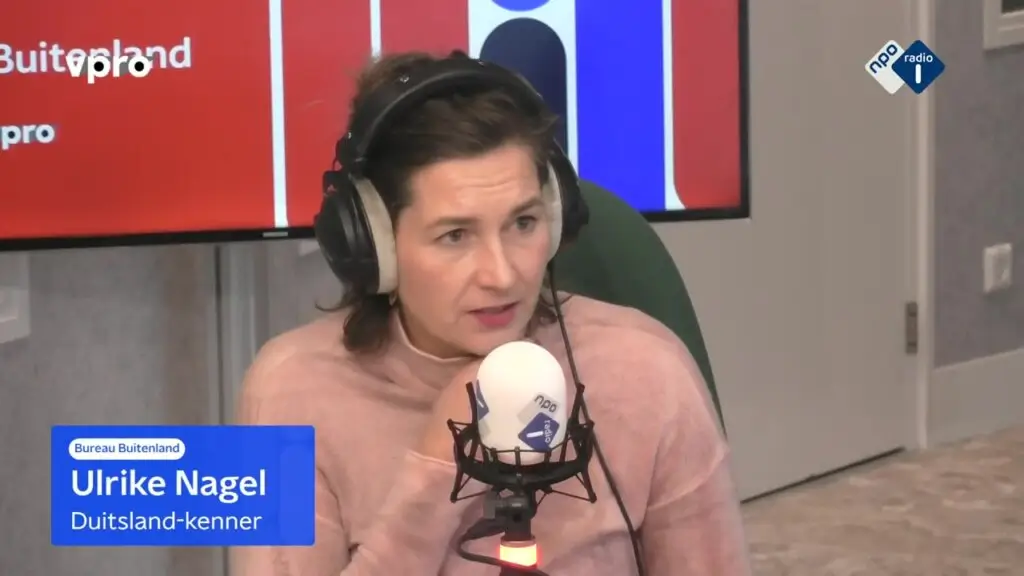
Ulrike Nagel in the Radio 1 studio with Wierd Duk, René Cuperus, Jan Willem Wesselink, and Robbert Meeder.
Summary of the Discussion
Introduction and Immigration Policy [00:02]: The discussion on Radio 1’s “Nieuwsforum” with Ulrike Nagel begins with the tension in Germany surrounding right-wing extremism and the upcoming elections in February. There is concern about stricter asylum legislation that initially failed to secure a majority but for which a motion was later passed with the support of the far-right AfD party [00:09]. This sparked a great deal of debate, especially since other parties had previously ruled out cooperation with the AfD [03:05].
Impact of Incidents on the Debate [03:19]: The program discusses how recent attacks, such as those in Aschaffenburg and Magdeburg, have influenced the debate on migration in Germany. An incident in Aschaffenburg, in which a deported Afghan man murdered a toddler, sparked outrage and calls for stricter measures. This has shifted the discussion from the economy to migration as the main election issue [03:49].
Historical Context and the AfD [07:50]: German history plays a major role in how Germany deals with right-wing populism and the AfD. Memories of the Weimar Republic and the rise of Hitler make the centrist parties reluctant to cooperate with far-right parties. The discussion touches on the “firewall” built around the AfD [11:43] and how controversial statements by AfD members—such as those regarding the Holocaust memorial—contribute to other parties’ aversion to the AfD [15:13].
Economic Situation in Germany [41:14]: The economic situation in Germany is also discussed, which is described as “bad” and “stagnant”. Criticism is directed at the lack of innovation, risk aversion, and the consequences of Angela Merkel’s “Energiewende” [41:56]. The phase-out of nuclear energy and dependence on Russian gas have led to high energy costs, causing industries to relocate [43:53]. The “debt brake” in the constitution also limits opportunities for investment in infrastructure and modernization [44:52].
The Future of German Politics and Europe [44:05]: The program concludes with a look at the upcoming elections and their potential consequences for Germany and Europe [25:53]. The possibility that the AfD could become the largest party is viewed with concern, although there is significant opposition to it in Germany [25:58]. There are concerns about political instability and Europe’s role in a changing world, particularly due to the U.S.’s withdrawal under Trump and the unstable France-Germany axis.
On *Langs de Lijn En Omstreken*, you’ll hear not only live sports but also special stories. You can enjoy exciting matches as well as fascinating conversations with interesting guests. And in the meantime, we’ll bring you up to speed on the evening’s news. We produce the program in collaboration with the EO and the NOS. Hosts: Jan Willem Wesselink, Robbert Meeder.