Journalist | Editor | Chairperson | Germany expert / correspondent | in Hilversum & Berlin
On “Nieuwsweekend”: German elections could herald a “reassessment of all values”
Germany will elect a new parliament this weekend. Nearly 60 million residents are eligible to vote tomorrow. In the polls, the Christian Democrats led by opposition leader Friedrich Merz have a comfortable lead, followed by the far-right AfD. The key election issues are the struggling economy and immigration policy.
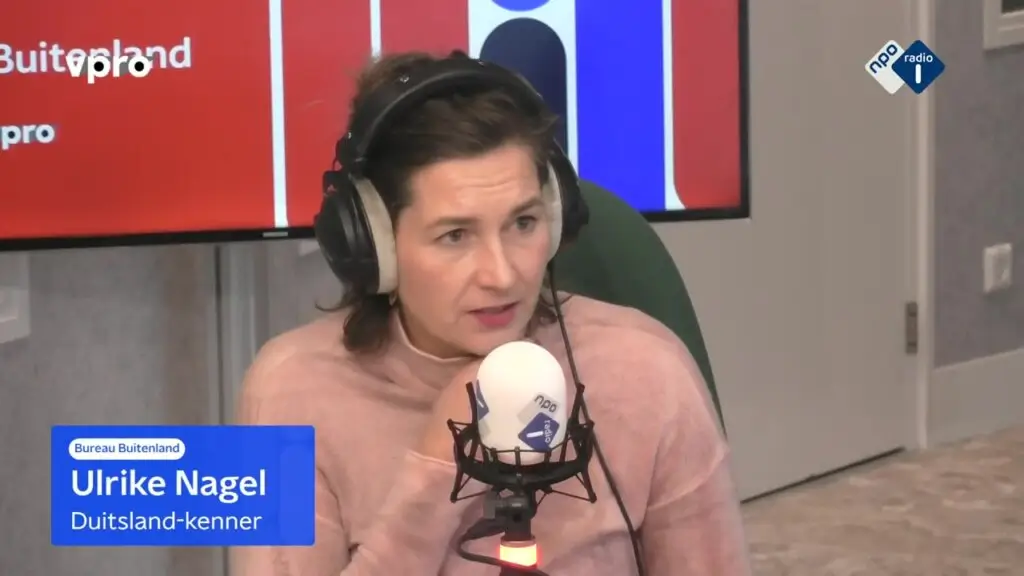
Ulrike discusses the German elections on Radio 1’s “Nieuwsweekend.”
00:00 Nieuwsweekend, Pieter van der Wielen 00:32 Ulrike Nagel
Ulrike Nagel talks on Radio 1 about Germany, which is electing a new parliament this weekend.
Topics covered in this interview
The German elections are just around the corner, and the atmosphere in Germany is tense. Ulrike Nagel, an expert on Germany, discusses the potential “Umwertung aller Werte” (shift in values) that these elections could bring about.
Tension in Germany [00:28]: Although polls show Friedrich Merz’s Christian Democrats in the lead, there is a lot of commotion, and the elections are a major topic of discussion among the population. Nagel’s own parents, who are center-left voters, are following the debates closely, while friends and family members who vote for the AfD are sparking debate [01:07].
Shift in German Politics [01:49]: Traditionally dull and nuanced German politics has changed. Angela Merkel’s reserved and cautious approach, which led to little contact between politicians and citizens, has contributed to the current discontent. Germans are accustomed to maintaining a hierarchical distance from politics [03:36].
Impact of COVID-19 and Polarization [03:48]: The COVID-19 pandemic has further widened the gap between politics and the public, with radical measures and a lack of willingness to listen to the public’s concerns. This has resulted in a polarized society, where citizens either defend democracy or distrust the government and public media [04:12].
Merkel’s Legacy and Economic Challenges [04:56]: Angela Merkel’s legacy is under debate. Although she provided stability, she neglected infrastructure problems and shortcomings in digitalization. The “Schuldenbremse” (debt brake) in the constitution, though intended as a savings measure, now hinders investments in defense, energy, and infrastructure, despite European directives that allow for more flexibility [06:25].
Merz and the AfD Strategy [08:07]: The new chancellor, likely Friedrich Merz (CDU), faces the challenge of opening the purse strings for necessary investments. However, his popularity has come under pressure due to the breach of the “firewall” against the AfD. The CDU submitted a motion on migration that was passed with the support of the AfD (although the bill ultimately failed) [08:26]. This went against the agreement among all parties to keep the AfD out, even by resubmitting good ideas from the AfD itself under their own name [08:54]. Nagel notes that Dutch journalists and voters find it difficult to ignore a party that ranks so high in the polls. All of this is closely linked to Germany’s wartime past [09:11].
Ulrike Nagel speaks on Radio 1 about Germany, which is electing a new parliament this weekend.
Ulrike emphasizes that Germany is facing a crucial moment, in which the past, current political dynamics, and economic realities present a complex challenge.