Journalist | Editor | Chairperson | Germany expert / correspondent | in Hilversum & Berlin
Radio 1: Berlin Elections Again
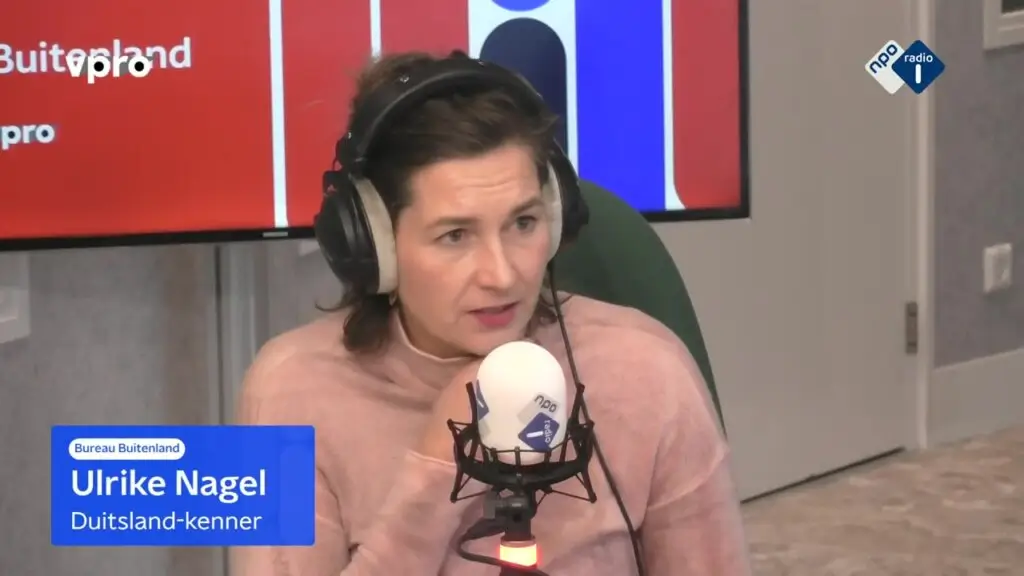
Running out of ballots, endless lines, and not enough ballot boxes. Due to numerous organizational errors, the 2021 Berlin elections must be held again. This is a first in history. However, it’s not new for the city government to make a mess of things, says Germany expert Ulrike Nagel on “Bureau Buitenland.”
Summary of this conversation
Elections throughout Berlin must be repeated. Germans are known for their punctuality, but city officials in Berlin seem completely unfamiliar with the concept and often make a mess of things [00:16]. The situation has now become so dire that the municipal elections must be held again [00:29]. Germany expert Ulrike Nagel discusses the situation [00:33].
Chaos in the Berlin Elections
The average Berliner is used to standing in long lines for municipal services, with weeks or even months of waiting time for a driver’s license or passport [00:41]. However, last September’s municipal elections were even more chaotic than Berliners are used to [00:58]. A court has now ruled that Berlin’s 3.7 million residents must return to the polls [01:04]. This is remarkable, given that a mayor (Franziska Giffey of the SPD) has been in office for just one year [01:10].
Problems During the Elections
Long lines: [01:16] Due to the extremely long lines at the polling stations, many people didn’t cast their ballots until after 6:00 p.m..
Results on television: [01:26] At that point, the first election results were already being shown on television, or voting had come to a complete standstill.
Incorrect ballots: [01:32] It turned out that too few ballots had been printed, or that some were incorrect [01:26].
The judge ruled that many Berliners were still standing in line when the first results were already known, which is “unacceptable”.
Expectations and dilemmas for the repeat election
Ulrike Nagel wonders whether things will go smoothly this time [01:43]. Although the Dutch often think this is “unprofessional,” it is “certainly not un-Berlin-like” [01:47]. The election campaign has already kicked off, but this is leading to “some very strange scenes” [01:57].
Specific challenges:
Exact repeat: [02:02] The election must be repeated exactly as it was, with the same slates and the same candidates.
Political switch: [02:06] A female politician who ran for the Green Party last year has since switched to Die Linke (the city’s most left-wing party). She now faces a dilemma, because she’s actually on the list for her old party, but doesn’t want that at all [02:17].
Exciting mayoral election: [02:24] It will also be exciting to see whether the SPD mayor, Franziska Giffey, can retain her seat. She has a direct rival from the Green Party, and last year it was already a neck-and-neck race [02:29].
Berlin elections must be held again
Background
The average Berliner is used to waiting in long lines at city hall. Applying for a driver’s license or a passport often takes several weeks, sometimes even several months. The organization is so disorganized that it even affected the city council elections last September. Those elections were so chaotic that the Constitutional Court of the State of Berlin ruled that Berliners must return to the polls.
“Due to the long lines at the polling stations, many people didn’t cast their ballots until after 6 p.m. or were unable to vote at all. It also turned out that too few ballots had been printed, and there were even some incorrect ballots among them. This led to preliminary results being announced while many Berliners were still standing in line, which the court deemed unacceptable,” Nagel explains.
Election Battle
The election battle has already begun, leading to some remarkable scenes. This is because a requirement is that exactly the same candidate lists be used as last time. “For example, there’s a female politician who ran for the Green Party last year but has since switched to Die Linke, the city’s most left-wing party. So now she faces a dilemma, because she has to appear on the list for her old party—and she really doesn’t want to,” explains the Germany expert.
But all eyes are also on the mayor’s seat. It’s entirely possible that the Greens could become the strongest party instead of the SPD. Incumbent Mayor Franziska Giffey of the SPD would then have to make way for Bettina Jarasch, the Greens’ senator for the environment and mobility. “That was already a neck-and-neck race last year,” says Nagel. The court has ruled that all decisions made so far this year remain legally valid and that all politicians will remain in office until the new elections.
39 million
A budget of 39 million euros has been allocated for the repeat elections in Berlin at the federal, state, and district levels. That is three times as much as in 2021. So money won’t be an issue this time. Berliners will likely head to the polls again on February 12, hoping that city officials will have their affairs in order by then.
On “Bureau Buitenland,” you’ll hear international news, reports, and geopolitical analysis. Featuring background stories and noteworthy reports, Monday through Friday from 1:30 to 2:00 p.m. Hosts: Sophie Derkzen and Tim de Wit