Journalist | Editor | Chairperson | Germany expert / correspondent | in Hilversum & Berlin
On VRT Radio 1: Elections in the German state of Brandenburg
Elections will be held in the German state of Brandenburg on September 22. “It promises to be a neck-and-neck race between the SPD, which has held the office of minister-president there for 30 years, and the far-right AfD.” Listen to journalist and Germany expert Ulrike Nagel in conversation with Jan van Delm on Flemish radio.
Summary of the conversation ↴
Introduction to the Elections in Brandenburg Elections are taking place today in the German state of Brandenburg. This is the third state in eastern Germany to go to the polls this month, following Saxony and Thuringia on September 1. In Saxony and Thuringia, the far-right AfD scored a major victory, sweeping aside most of the traditional parties [00:12]. Journalist and Germany expert Ulrike Nagel, who was born and raised in East Berlin, discusses the situation in Brandenburg [00:19].
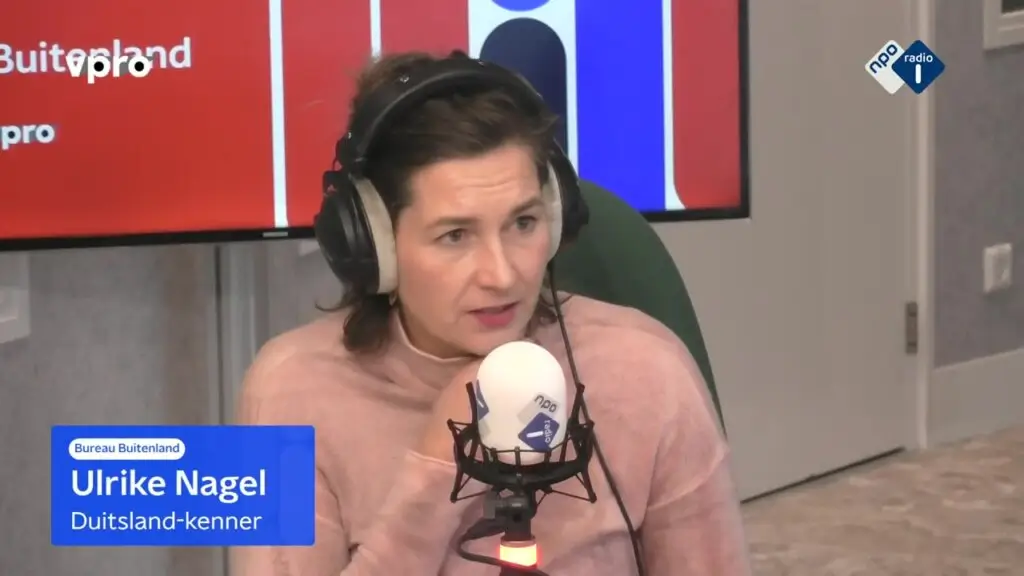
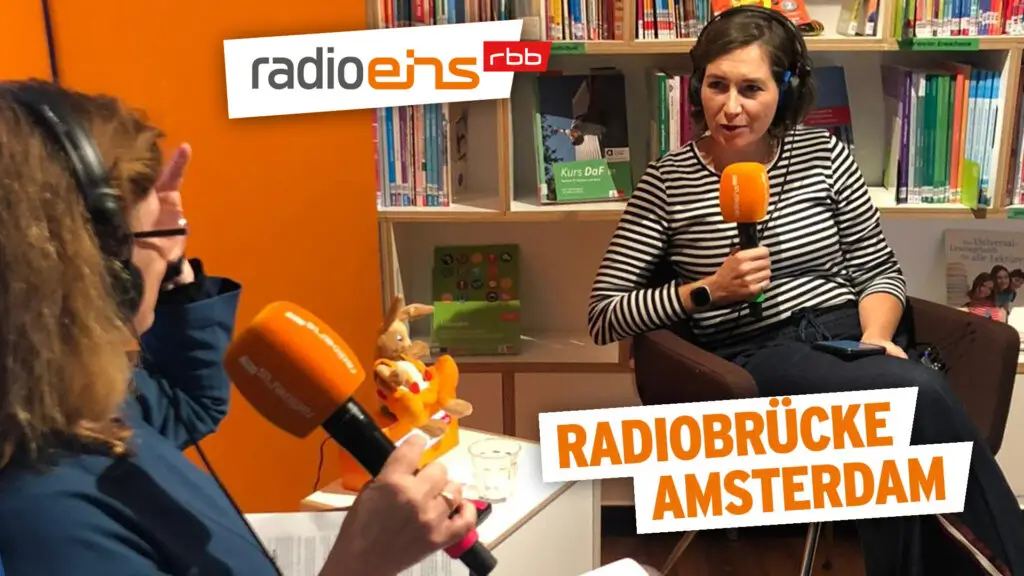
Ulrike Nagel on VRT Radio 1 discussing the elections in Brandenburg.
A neck-and-neck race in Brandenburg [00:32] According to the polls, it will be a neck-and-neck race between the SPD—which has provided the state premier for 30 years and is the most stable SPD party in the country—and the AfD [00:32]. The polls predict a very close result, which means the SPD may hold on to power [00:47]. Popularity of the SPD Minister-President [00:52] The SPD’s stability has a lot to do with the Minister-President, Dietmar Woidke, who has been at the helm for more than 10 years [00:58]. He is a quiet, calm, and pragmatic man who truly focuses on what’s best for his state [01:02]. Although the SPD is a center-left party, he doesn’t just do center-left things [01:09]. For example, he brought Tesla to Brandenburg with a large factory [01:20]. Brandenburg has traditionally been a state with little industry and where lignite is processed—a sector that really needs to be phased out [01:27]. Woidke has ensured that the phase-out of lignite mining is being extended and is actively seeking alternatives for the future [01:33]. His approach has made him popular [01:43].
Map of the German state of Brandenburg.
Sahra Wagenknecht’s Party (BSW) [01:47] A third party in the spotlight is Sahra Wagenknecht’s Party (BSW) [01:47]. Wagenknecht, born in East Germany, is known as a “maverick” in German politics [01:54]. Incidentally, many of the party leaders running for office in Brandenburg also come from East Germany, which is noteworthy [01:59]. Wagenknecht, who emerged from a left-wing party, is positioned on the far left and places a strong emphasis on the idea of peace in relation to support for Ukraine [02:15]. This strikes a chord with many people who don’t want war [02:28]. Expectations for the BSW in Brandenburg [02:35] In other states, the BSW has risen from 0 to 16% in the polls [02:36]. In Brandenburg, they are expected to end up at around 13% [02:49]. This means the BSW could become a key player in coalition-building, as other parties, such as the Greens and the CDU, are losing ground [02:55]. If the SPD gains significant ground and ties with the AfD, the SPD will need the BSW to form a government [03:06]. This could make the situation very tense [03:22]. East German Voting Behavior and Disillusionment [03:29] The divergent voting behavior in the East German states is complex and has numerous causes [03:30]. Nagel explains that it’s not necessarily about a lack of East Germans within the traditional parties, because there are actually many of them [03:46]. It’s a mix of the feeling that “nothing ever changes” and, at the same time, a reluctance to embrace even more change [03:58]. Thirty-five years ago, East Germans experienced a massive upheaval—something the western part of Germany finds hard to imagine [04:04]. The constant call to be open to new things and to look ahead is moving too fast for many [04:18]. Unfortunately, they often end up choosing parties that make big promises, but it remains to be seen whether they can deliver on those promises [04:29].
Ulrike Nagel in the Radio 1 StudioBackground ↴
According to exit polls, the Social Democratic Party (SPD) has emerged as the largest party in the elections in the eastern German state of Brandenburg. The far-right Alternative for Germany (AfD) is close behind. According to exit polls, the SPD is projected to receive 30.7 to 30.9 percent of the vote. The far-right AfD follows with 29.4 percent of the vote. In the polls, however, the AfD had actually been in the lead, with Chancellor Olaf Scholz’s party trailing closely behind. Although the AfD has become the second-largest party, it will end up in the opposition. The other parties do not want to cooperate with it. The AfD in Brandenburg is viewed by the domestic security service, the Verfassungsschutz, as a potential far-right group—a so-called “Verdachtsfall”—which grants the service additional powers to monitor the party. Several AfD members of the Brandenburg state parliament are considered far-right, including party leader Hans-Christoph Berndt.
“De Ochtend” is a current affairs radio program broadcast on the Flemish public radio station Radio 1. “De Ochtend” airs on weekdays from 6 a.m. to 9 a.m. The program consists mainly of reports, contributions from staff in Flanders and correspondents abroad, and live interviews, supplemented by plenty of music.