Journalist | Editor | Chairperson | Germany expert / correspondent | in Hilversum & Berlin
Radio 1: East Germans Give the Governing Coalition a Red Card
The AfD has become the largest party in the German state of Thuringia. The far-right party also scored a landslide victory in neighboring Saxony, where it finished in second place. Meanwhile, the left-wing populists led by politician Sahra Wagenknecht are also gaining ground. Chancellor Scholz called the results of the state elections “bitter”: the ruling parties suffered significant losses.
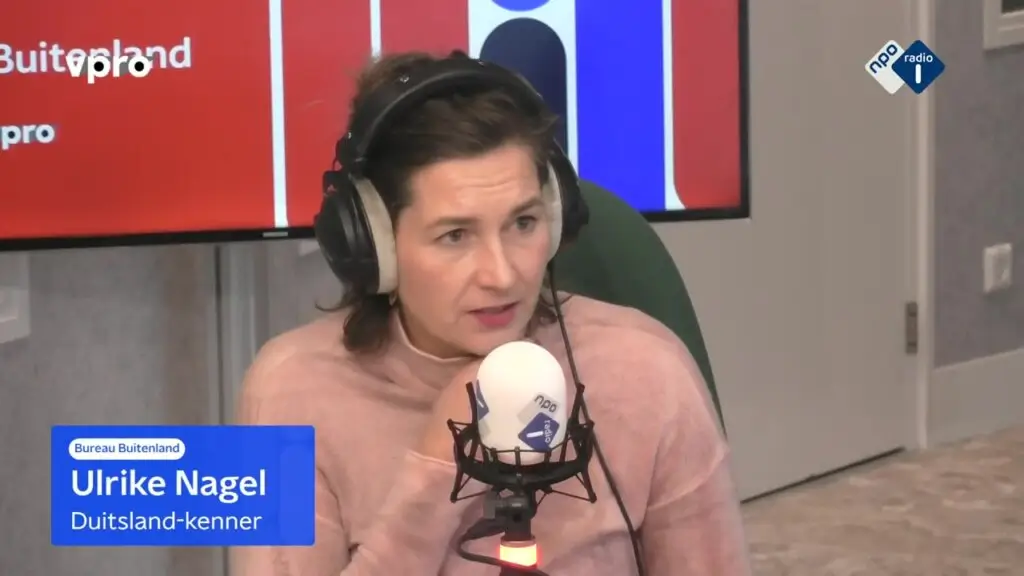
Germany expert Ulrike Nagel spoke with Sophie Derkzen on Radio 1 about the discontent among East Germans and the call for change.
Summary of the conversation ↴
Journalist and Germany expert Ulrike Nagel discusses the results of the state elections in Thuringia and Saxony, where the AfD became the largest party, despite being classified as far-right by security agencies.
Elections in East Germany and the Rise of the AfD
AfD as the Largest Party [00:26]: In the state elections in Thuringia, the AfD became the largest party, and in Saxony, the party received nearly one-third of the votes. This is remarkable, given that the AfD has been classified as far-right by security agencies in both states. Other parties are ruling out cooperation with the AfD for the time being.
Protest Votes [01:09]: Ulrike Nagel spoke with her uncle, who voted for the AfD. He explained that it was a protest vote, driven by dissatisfaction with the lack of change in areas such as the teacher shortage and the economy. For him, the ideological background of the party leader, Björn Höcke (who has been classified as far-right), was less important than the desired change.
Firewall and Polarization [08:05]: According to voters, the cordon sanitaire—or “firewall”—that other parties have erected around the AfD is backfiring. The AfD refused to allow journalists into their campaign rallies, which the established parties use as an argument for refusing to engage with them. This makes it difficult for voters to assess whether the AfD could actually bring about change. Nagel emphasizes that people who vote for the AfD are not necessarily “nationalists” [10:15].
Rise of the BSW [04:51]: In addition to the AfD, the Bündnis Sahra Wagenknecht (BSW), a splinter group of Die Linke, was also successful, particularly in Saxony. This party benefits from the traditional East German preference for parties that champion the interests of East Germans. The BSW advocates for peace and opposes arming Ukraine, a position that resonates strongly in East Germany, where people were raised with the idea that the military ensures peace [06:05].
Implications for German Politics and the Coalition
A Setback for the Governing Coalition [07:05]: The results represent a severe setback for the national governing coalition of the SPD, the Greens, and the FDP. All three parties performed particularly poorly, with the FDP failing to clear the 5% electoral threshold [07:18]. Chancellor Scholz called the results “bitter and worrying” and called for unity against the far right [07:49].
Impact on Support for Ukraine [10:31]: Support for Ukraine is a key issue in eastern Germany, even though these are regional elections. The CDU, which may have to cooperate with the BSW to form a government, will likely have to shift its stance on Ukraine. The FDP failed to clear the electoral threshold, which complicates coalition-building and forces the centrist parties to make adjustments.
Regional Issues [12:44]: Nagel concludes that regional issues, such as education and the local economy, are apparently of great importance to voters in the states, and that the incumbent coalition has failed in this regard.
The coming period will be turbulent for German politics, with possible shifts in national policy, particularly regarding cooperation with the BSW and support for Ukraine.
Background ↴
According to the exit poll, the Alternative for Germany (AfD) has become the largest party in the elections in the eastern German state of Thuringia. In Saxony, it is a neck-and-neck race with the Christian Democratic Union (CDU).
In Saxony, the AfD stands at 30 percent and the CDU at 31.5 percent of the vote.
The elections in two eastern German states on Sunday resulted in a historic victory for the far-right AfD. The national governing parties have been swept aside. Germany’s democratic center is watching the elections with trepidation; national elections are scheduled for next year.
In Thuringia, the AfD was already well ahead in the polls this morning. According to the exit poll, the party received 30.5 percent of the vote; the Christian Democratic Union (CDU) trailed with 24.5 percent.
The governing coalition led by Social Democratic Chancellor Olaf Scholz has suffered a significant defeat in both states. His SPD received about 6.6 percent of the vote in Thuringia and 7.8 percent in Saxony. The Greens are on track for 4 and 5.2 percent, respectively, while the liberal FDP failed to clear the electoral threshold in either state. They did not exceed about 1 percent of the vote.
On “Bureau Buitenland,” you’ll hear international news, reports, and geopolitical analysis. Featuring background information and noteworthy stories, Monday through Friday from 1:30 p.m. to 2:00 p.m. Hosts: Sophie Derkzen and Tim de Wit