Journalist | Editor | Chairperson | Germany expert / correspondent | in Hilversum & Berlin
On Radio 1: Friedrich Merz gets off to a rocky start as chancellor
Germany has a new chancellor: Friedrich Merz. But his inauguration was anything but smooth. In the first vote, he unexpectedly fell six votes short—a rarity in German politics. What does this false start mean for his authority and leadership? Tijs van den Brink discusses this with René Cuperus and Ulrike Nagel, an expert on Germany.
Introduction to the Appointment of Friedrich Merz as Federal Chancellor
Friedrich Merz was finally sworn in as Germany’s chancellor this afternoon, following a chaotic day unprecedented in German politics. Against all expectations, Merz failed to secure enough support in parliament during the first vote this morning [00:25]. He now begins his term as a battered chancellor. René Cuperus and Ulrike Nagel discuss what Germany and Europe can expect from him [00:36].
The Unexpected Delay [00:41] Ulrike Nagel noted that Merz’s family was already present this morning and the German president was ready to welcome him, and that trips to France and Poland had been planned [00:41]. When the vote didn’t go well, everyone got nervous [00:52]. René Cuperus even called it “amateurish” that this hadn’t been anticipated, since the parliamentary groups should normally be well prepared for such an important decision [01:17]. The votes were secret, so it’s unclear who cast the dissenting votes [01:27]. There is speculation about score-settling and discontent, including within the SPD [01:32].
The second vote and its consequences [02:00] This morning, Merz received 310 votes, but this afternoon that number rose to 325 [02:00]. It is suspected that there was a lot of “shouting” and heated debate to secure the additional votes [02:25]. The incident is being called a “chancellor’s scandal,” and he is being blamed for failing to keep his own people in line [02:54]. The criticism is that if he cannot retain the politicians around him, how is he supposed to keep the people of the country united [03:05].
Secret ballots in Germany [03:37] Ulrike Nagel believes that the truth about the secret vote will likely never come to light, because Germans are very cautious about secret ballots, even when electing a parent representative in the classroom [03:37]. The crisis was short-lived because a second vote took place immediately, making it seem like a “workplace mishap” [04:21].
The Start of the Chancellorship [04:41] Merz is off to a “rocky” start, with “two black eyes and wobbly knees” [04:41]. This looks bad on the international stage, especially since Germany wants to project stability in Europe [04:53]. At home, he has to contend with the AfD, which sometimes leads in the polls and has been officially designated as extremist [05:06]. The coalition’s majority is very slim, which opposition parties are immediately using to criticize its “shaky foundation” [05:28]. This could be a “Denkzettel,” a warning to try harder [05:44].
Merz’s personality and leadership [05:57] Nagel thinks this could be a good start for Merz to realize he needs to work harder, although a power-hungry politician might feel differently about it the next day [06:05]. His travels will continue as usual [06:19]. René Cuperus is impressed by Merz and finds him to come across as stronger than Scholz, both in social interactions and in his ability to pull the economy out of the slump and invest in Europe [06:29]. Merz must govern in such a way that this incident is forgotten in six months [07:16].
The AfD’s reaction [07:22] The AfD was pleased with the chaotic situation, and their leader, Alice Weidel, called for new elections and Merz’s resignation [07:22]. Weidel’s party was officially designated as far-right by the German intelligence service last week [07:53].
Can Merz take the wind out of the AfD’s sails? [08:04] Ulrike Nagel believes this is the most important question of all [08:04]. Merz comes across as energetic and decisive [08:14], but the question is whether he can connect with citizens in the federal states, which have a great deal of autonomy [08:20]. He needs to connect with some of the people who voted for the AfD and make them feel that he’s sincere [08:43]. Otherwise, the polls—which show the AfD’s support to be so high—will not shift [08:54]. He must do more than just give good speeches and speak decisively [09:10].
Challenges for the coalition [09:21] René Cuperus emphasizes that this coalition of the SPD (backed by the Greens) and the CDU/CSU (backed by the AfD) is a complex arrangement [09:21]. The SPD, which suffered an election defeat, must reinvent itself alongside the most conservative Christian Democrats [09:33]. The question is how much leeway Merz and the CDU/CSU will be given to act on migration and asylum issues without losing the SPD’s support [09:48]. The SPD must focus heavily on social policy and economic equality to push the AfD out of power, and the question is how much leeway they will be given by the neoliberal Christian Democrats [09:56]. These tensions were already present within the coalition, even before today’s launch [10:11].
Financial Opportunities and Europe’s Role [10:27] Financially speaking, the coalition has more opportunities than ever [10:27]. They have lifted the debt brake, giving them unlimited funding for a massive 500 billion infrastructure package [10:31]. Merz has many Christian Democratic friends in Europe, which offers a unique opportunity to accomplish a great deal in Europe [10:51]. Nagel, however, is concerned that Merz, as a wealthy conservative West German politician, will struggle to connect with ordinary people in the provinces [11:10].
The issues that matter to citizens [11:43] Centrist parties often mimic extreme parties, but Cuperus does not subscribe to that theory [11:43]. He believes that centrist political parties must dare to address the issues that concern citizens, such as asylum, migration, and inequality [11:54]. If you don’t focus on those issues, you’ll “get left behind” as a centrist party [12:18]. Merz has already made promises he hasn’t kept even before becoming chancellor [12:37], such as closing the borders or tinkering with the “Schuldenbremse” (debt brake) [12:40]. However, he has also responded to international developments since the election, which demonstrates leadership [12:57].
Merz in Europe and his image [13:35] Merz’s foreign minister, also from the CDU, had been traveling for weeks before Merz was elected, similar to what Trump did [13:21]. Merz is an “Atlanticist,” close to the United States, and responds sharply [13:42]. René Cuperus believes Merz can play an important role in Europe, given his ambition and charisma [14:18]. Scholz faded into the background due to his caution [14:27]. Nagel also thinks he can do it, despite her criticism of German humor [14:51].
Balance between domestic and European agendas [15:00] Merz will have a lot to do with Starmer and the “coalition of the Willing” [15:00]. Germany hasn’t really been visible on the international stage for the past six months [15:10], and Merz must fill this gap. The challenge is to strike a balance between the energy required for Germany (AfD, the economy, the auto industry) and the energy left over for the European agenda [15:15].
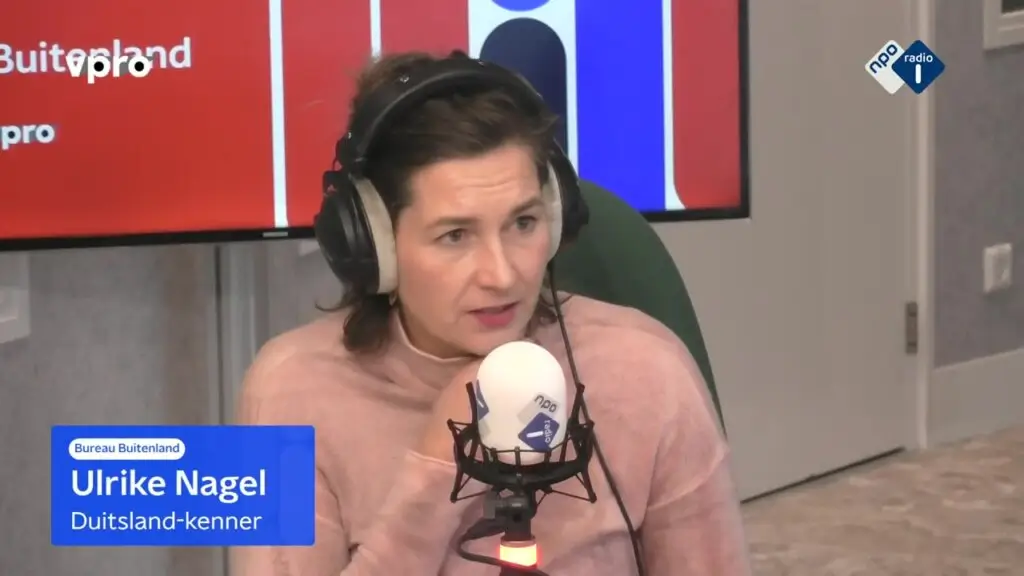
Ulrike on Radio 1’s “Dit is de Dag” with Tijs van den Brink, discussing how Merz didn’t have enough votes to become Chancellor.Background ↴
Friedrich Merz was elected chancellor on his second attempt. After losing the first round of voting, he secured the necessary votes. Merz then received his certificate of appointment from Federal President Steinmeier. CDU leader Friedrich Merz was elected chancellor on his second attempt. The 69-year-old secured the required majority of more than 316 votes in the Bundestag this afternoon. 325 members of parliament voted for him, 289 against him, with one abstention. The new governing coalition of the CDU/CSU and SPD holds 328 seats in parliament.
Merz Elected Chancellor Only on Second Try
Merz has accepted the election. Outgoing Chancellor Olaf Scholz was among the first to congratulate him. Federal President Frank-Walter Steinmeier then received Merz at Bellevue Palace and presented him with his certificate of appointment. After receiving the certificate, the new chancellor took office, and Merz was sworn in at the Bundestag early this evening. The appointment and swearing-in of the new federal ministers are also scheduled for later. A cabinet meeting will also take place this evening.
Merz Fails in the First Round of the Chancellery Election
Historic defeat in the first round of voting Earlier that morning, Merz had failed to secure the required majority in the first round of voting—an unprecedented event in the history of the Federal Republic of Germany. He received only 310 votes in the secret ballot, six short of the required majority. Although the CDU/CSU and SPD parliamentary groups were, according to their own statements, fully represented, 18 members of parliament must have voted against Merz. Exactly who refused to vote for the CDU leader is unknown due to the secret ballot.
Rules Amended
Following the historic election debacle, the Bundestag session was suspended for several hours. This was followed by lengthy consultations among the parliamentary groups regarding the date for a second round of voting. Behind the scenes, the party leaders and top politicians negotiated a new election date. Initially, the CDU/CSU had stated that there would be no second round of voting today, but an agreement on a second round was reached early this afternoon. The Bundestag amended its rules with the required two-thirds majority to make the election possible today. The CDU/CSU, SPD, Greens, and Left Party parliamentary groups had jointly requested this.
The radio program *Dit is de Dag*, broadcast on NPO Radio 1, is a daily show that airs from 6:30 p.m. to 7:00 p.m. The program focuses on discussing current events and social issues. During the broadcast, various guests—including experts, politicians, and stakeholders—are invited to share their perspectives and opinions on relevant topics.