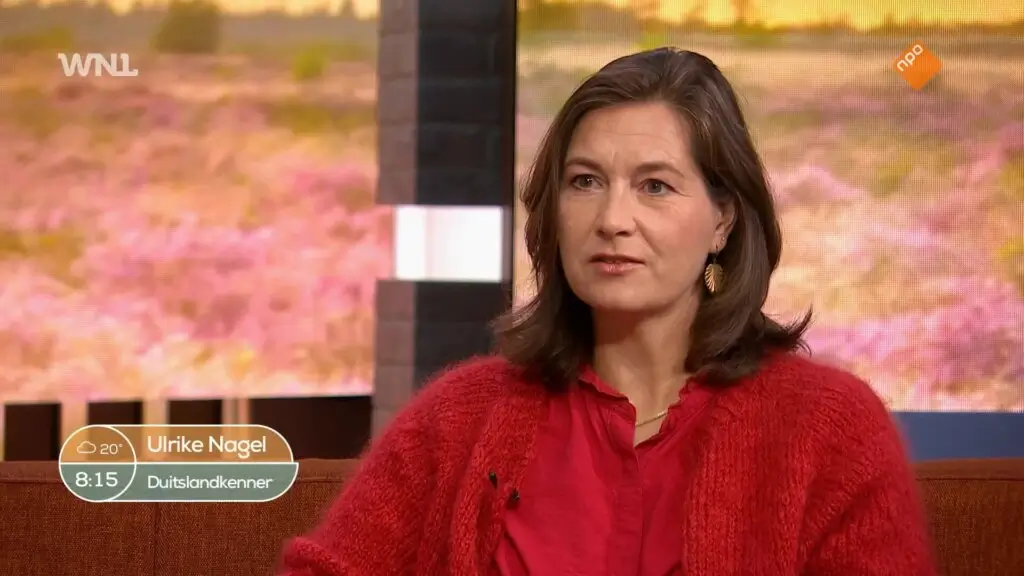
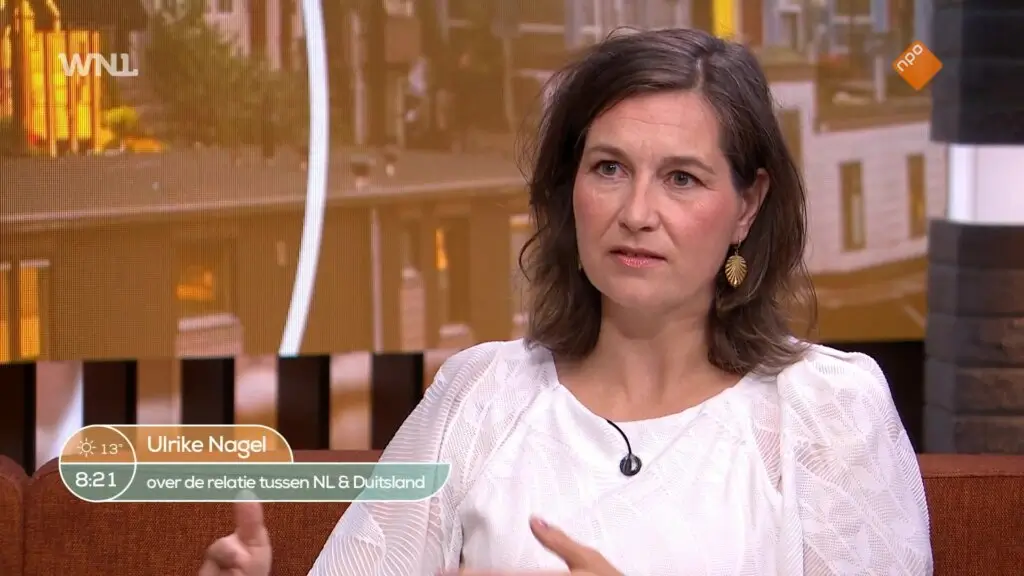
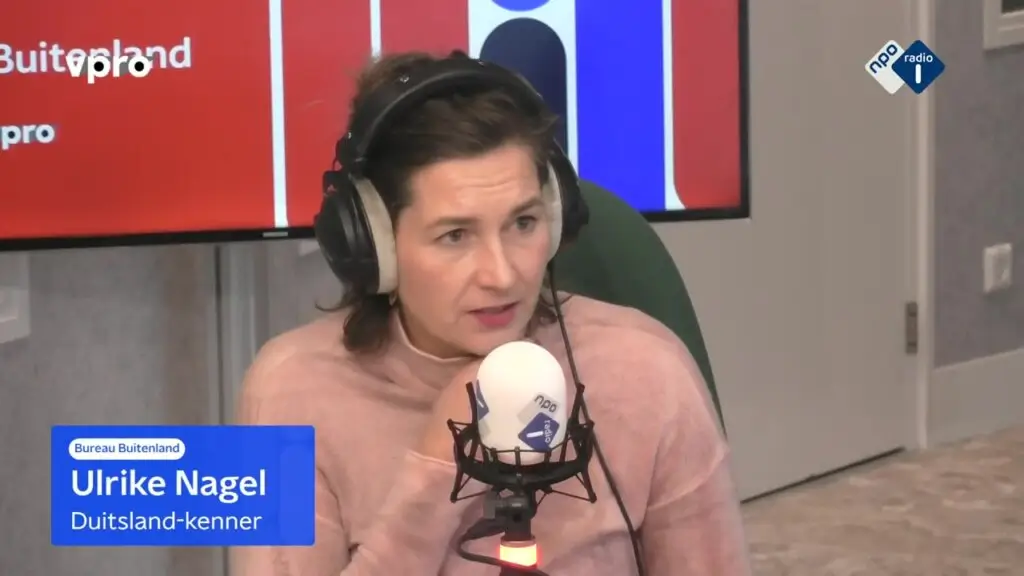
Ulrike was a guest on the show *Tijd voor Max* and spoke with the other guests and host Martine van Os about the German parliamentary elections.
Guests: Ulrike Nagel, Leendert de Ridder, Henriëtte Tol, Iris de Graaf, Yana Popova, Muza Valiaddinzade, Josine Droogendijk.
Summary of the discussion ↴
German parliamentary elections [00:16] Germany elected a new Bundestag yesterday. According to preliminary results, the CDU/CSU coalition became the largest party with nearly 28.5% of the vote [00:16].
Ulrike Nagel on the results [00:29] Ulrike Nagel wasn’t really surprised by the results, because the projections and polls were close to the actual outcome [00:33]. She was, however, anxious that the results might turn out very differently, especially since there had been speculation in the Netherlands about the possibility that the AfD might become the largest party [00:43]. In Germany, that wasn’t really a topic of discussion [00:48].
The “gruesome” map of Germany [00:54] Nagel was, however, startled by the election map of Germany, which she finds “quite gruesome” [00:59]. Eastern Germany is almost entirely blue (the AfD’s color), while the west is virtually black (the CDU’s color) [01:05]. This is reminiscent of the situation in the past, as if the border still existed [01:18]. Especially in the east, near the Polish border, as many as 35% of voters supported the AfD [01:29].
Reasons for the rise of the AfD [01:40] It’s not easy to explain why the AfD is so popular in the east [01:40]. Many people in those regions are disappointed with the centrist parties and want change [01:52]. Historians criticize them, saying they no longer have any idea what the country was like 35 years ago, but people only remember the good things about the East [02:06]. The AfD capitalizes on this sentiment [02:20]. The centrist parties have lost touch with the public; especially at the local level, the disconnect is quite significant—unlike in the Netherlands, where politicians are closer to the people [02:24].
History and Development in East Germany [03:03] In 1990, all East Germans voted for the CDU because they wanted to be part of the West [03:03]. In the early years, they were in “survival mode,” having to survive and transition from a socialist to a market-based economic system [03:16]. They quickly realized that little consideration was given to their way of thinking and their education [03:39].
High Voter Turnout and Migration as an Issue [04:01] The high voter turnout of 83% is the highest since March 1990 [04:01]. This shows that people consider it extremely important for things to change [04:08]. Migration is a key issue for the AfD [04:13]. It is striking that migration is such a major issue in the east, even though that region has the fewest migrants [04:26]. Eastern Germany used to be a homogeneous group; foreigners, such as Vietnamese, lived separately [04:31]. Fear of the unknown plays a role [04:50]. Berlin votes very differently—much more to the left—which came as a surprise [04:59].
Friedrich Merz and the Future [05:19] Friedrich Merz, the CDU party leader, exudes decisiveness and vigor, in contrast to Scholz and Merkel, who were more modest and reserved [05:19]. People in Germany expect someone who knows how to get things done [06:08]. Merz hopes to have a new government in place by Easter, partly due to the international urgency following the Munich Security Conference, where the U.S. signaled its withdrawal from Europe [06:21]. Merz has spoken out in favor of a stronger role for Germany within the EU [07:02].
Economic consequences for the Netherlands [07:27] The German election results will be felt most acutely in the Netherlands on the economic front [07:27]. Germany is the Netherlands’ largest trading partner (100 billion euros in annual trade) [07:30]. Trade will not be directly affected [07:43]. However, Germany is facing enormous economic problems; its industrial and automotive sectors are struggling due to a conservative approach [07:48]. The Netherlands can help Germany with its flexibility and swift approach, which could be a winning combination [08:09]. Germany needs to invest, but has not yet made any concrete statements on this [08:44].