In the run-up to the early German elections, a debate arose over the format of the televised debates. Public broadcaster ZDF initially planned two separate head-to-head debates: one between Scholz and Merz, and one between Weidel and Habeck. The latter met with resistance from Habeck, who advocated for a broader debate format.
Under pressure from political parties and public debate, several broadcasters adjusted their plans. The commercial network RTL expanded its debate to include four candidates. Merz indicated that he actually welcomed a direct confrontation with Weidel, while the CDU warned that larger panels would come at the expense of substantive depth.
🔗 https://duitslandinstituut.nl/artikel/62050/discussie-over-tv-debatten
One arena. Two people facing each other. Ready to begin a fight, swords at the ready. A real duel!
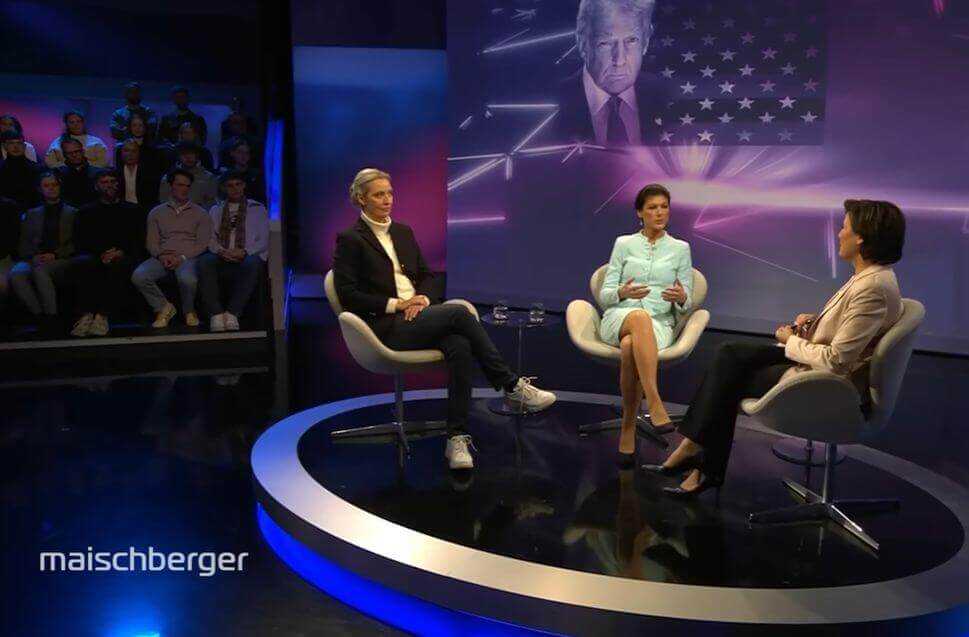
This image easily brings to mind the German term “TV-Duell.” A battle between two people. And that’s close to reality, because a duel between the leaders of political parties is a tradition in Germany. The weapons? Words.
Ever since the election campaign kicked off in December, the debates have come under fire. Once it became clear that early elections were on the horizon, the public broadcaster ZDF quickly scheduled a TV debate between the two candidates most likely to win the highest political office. One is still officially the chancellor—Olaf Scholz of the SPD—while the other is the candidate leading in the polls—Friedrich Merz, the CDU/CSU’s candidate for chancellor. In addition, the network had planned a second debate between Alice Weidel (AfD) and Robert Habeck (Bündnis 90/Die Grünen).
This immediately drew criticism from the other parties. Habeck responded through a spokesperson. A debate between him and the AfD was not the intention. “We said in advance that we would not do that and also stated that we would not accept such an invitation,” the Redaktionsnetzwerk Deutschland (RND) quotes the spokesperson as saying.
Overzicht van debatten:
9 februari, 20.15 uur - Scholz vs. Merz - ARD en ZDF met Sandra Maischberger en Maybritt Illner
16 februari, 20.15 uur - Scholz vs. Merz - RTL/ntv met Pinar Atalay en Günther Jauch
19 februari, 20.15 uur - Scholz vs. Merz - Welt tv
13 februari, 19.25 uur - Klartext! met Scholz, Merz, Habeck en Weidel - ZDF
17 februari, 21.15 uur - Wahlarena - Scholz, Merz, Habeck en Weidel beantwoorden  vragen uit het publiek - ARD
20 februari, 22 uur - Die Schlussrunde - alle topkandidaten - ARD/ZDF
23 februari: Berliner Runde
In Germany, the established political parties have agreed to a “cordon sanitaire” around the AfD: other parties do not cooperate with the AfD—a policy also known in German as a “firewall.” In the media, however, this agreement does not apply: the AfD is invited to appear on radio and TV programs.
Habeck himself later said he considered a debate between two candidates to be outdated. “The citizens decide who will govern our country. Germany has a choice, and that choice is no longer limited to two former ‘people’s parties.’ It would be good if this reality were also reflected in TV formats,” Habeck told Tagesschau.
FDP and BSW
Habeck wasn’t the only one to react to the broadcaster’s plans. The liberal FDP party also spoke out immediately. Party leader Christian Lindner said on X that he would be willing to take Habeck’s place in the debate. “We must not shy away from a contest of ideas with the AfD if we want to win back their voters.” And Sahra Wagenknecht of the new BSW party also said right away in December that she would have no problem debating Alice Weidel. That debate has since taken place; on January 23, Weidel and Wagenknecht faced off in one of the first debates of this election campaign.
AfD and CDU
The AfD said it would seek a legal review to determine whether it is justified that the party is only allowed to participate in “Ameisenrunden” (ant rounds). Since the AfD is currently in second place in the polls, the party also wanted to debate the CDU/CSU and the SPD—the traditionally major parties that have lost a significant number of seats in recent years.
The CDU, on the other hand, warned against TV debates with too many participants. “Politicians sometimes need half an hour or 45 minutes to explain their positions. Otherwise, populism will prevail over a factual analysis,” said CDU Secretary-General Carsten Linnemann. Furthermore, parties should not interfere with press freedom; public broadcasters should be allowed to decide whom to invite based on journalistic criteria.
That said, broadcasters are bound by rules in this regard. They must be able to justify their choice of format on sound journalistic grounds. Broadcasters are guided by the principle that coverage must be proportional—more attention for the larger parties, less for the smaller ones.
A debate between two, three, or four party leaders?
Journalist Sebastian Wellendorf spoke with Bettina Schausten, editor-in-chief and anchor at ZDF, for the German radio station Deutschlandfunk. Why, for example, didn’t the network also invite Robert Habeck to a debate among the three top candidates? According to Schausten, this decision was carefully considered. There will be two rounds of discussions, each featuring two party leaders. There will also be other debates, including the traditional “Elefantenrunde” (Elephant Round), featuring all party leaders, three days before the election. Before then, they wanted to offer viewers two in-depth debates.
Moreover, having three party leaders would be unusual. Based on the polls, the AfD would also have to be invited. Schausten felt it was better to schedule two TV debates, each lasting 90 minutes. This allows for more in-depth discussion and is therefore better for voters.
Now that the debate between Weidel and Habeck has been canceled, the two will receive extra attention in other programs, the public broadcaster announced.
RTL
The commercial channels RTL and N-TV had also planned a debate between Scholz and Merz. They caved to the pressure and announced in late January that they would also invite Weidel and Habeck to their TV debate on February 16. “What must be done, must be done,” said RTL’s political editor on Platform X.
Merz (CDU) has also since said that he is open to a broader debate. “My intention is to debate directly with Alice Weidel on TV. That will also make it clear that the AfD and the CDU have nothing in common,” Merz told regional media.
Merz and Scholz will now appear in multiple TV debates. This is quite different from former Chancellor Angela Merkel, who always insisted on participating in only one TV debate. As a result, public and commercial broadcasters had to collaborate, and the debate was aired simultaneously on all channels.
