Journalist | Editor | Chairperson | Germany expert / correspondent | in Hilversum & Berlin
Radio Luxembourg 100.7: Government Crisis in the Netherlands
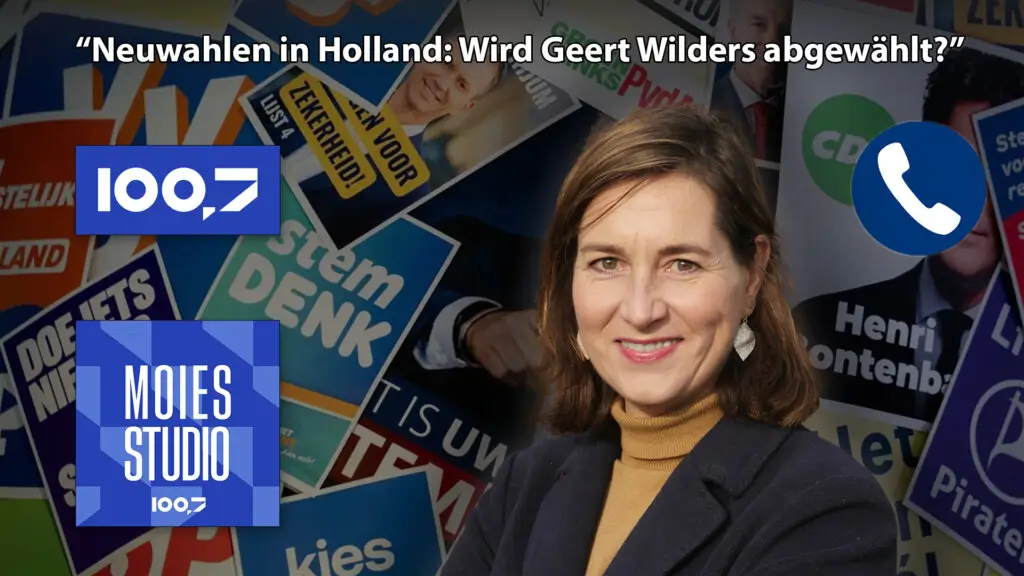
Why did right-wing populist Geert Wilders cause the coalition to collapse? Ulrike explains it over the phone in German to Rick Mertens of Radio Luxembourg.
Radio 100.7 Studio – Government Crisis in the Netherlands [00:01] The nationalists of Geert Wilders’ Party for Freedom (PVV) have broken off the coalition with three other parties [00:01]. This was because the PVV wanted a stricter asylum and immigration policy than the other parties [00:15]. Ulrike Nagel, a German journalist, discusses the situation.
Geert Wilders’ Ten-Point Plan [00:34] Last week, Geert Wilders presented a ten-point plan to tighten immigration policy. This plan went too far for his coalition partners [00:34], as it included closing the borders to asylum seekers, banning family reunification for refugees, and deporting foreign criminals [00:44]. Although not all points of this plan were included in the original coalition agreement, some had already been agreed upon [01:06]. There was talk of the strictest immigration policy ever [01:25], but Wilders reluctantly agreed to the compromises [01:30].
Wilders’ Motivation and Reactions [01:30] Wilders put the plan on the table because he felt that too little was being done regarding immigration in the country [01:44]. Although the immigration minister was a member of his party, little progress was being made [01:50]. Instead of resolving the issue internally, Wilders stepped forward to draw his voters’ attention to the immigration issue [02:02]. However, the cabinet refused to cooperate [02:07]. Wilders seemed intent on causing a rift [02:13], and although the other parties wanted to reach out to him, he rejected their offers [02:25]. This suggests that Wilders deliberately sought to break up the coalition [02:31].
Implications for future coalitions [03:04] Many ministers expressed their frustration and noted that Wilders had threatened to break the coalition on several previous occasions [02:38]. Although he was the winner of the election, he was dependent on other parties [02:46]. Several politicians have already stated that they do not want to govern with Wilders [03:44], because he has caused a government to collapse twice before [03:57]. Trust has been damaged, and Wilders is accused of acting irresponsibly [04:10]. He had the opportunity to exert influence but chose instead to prioritize himself and the political spotlight [04:25].
Outlook for New Elections [04:53] The exact date for new elections is still unknown, but they will likely not take place before October [04:53]. The summer and the NATO summit in June are delaying the process [05:02]. The outgoing cabinet will have to present the budget [05:18]. There are many unresolved issues, including asylum and migration, nitrogen emissions, housing, and the high cost of living [05:37].
Voter sentiment and possible outcome [06:40] It is still unclear how the fall elections will turn out [06:40]. Although Wilders has dropped in recent polls [06:54], many of his voters continue to support him [07:34]. However, some voters acknowledge that he is more of an opposition populist than an actual problem-solver [04:48]. It seems unlikely that Wilders will secure an absolute majority [07:41].
Ulrike on Radio Luxembourg 100.7 – Government Crisis in the Netherlands
Stay better informed throughout the day. Interviews, reports, and analysis from the 100.7 Morning Studio. Hosted by Rick Mertens. Radio 100.7 is a public radio station in the Grand Duchy of Luxembourg. Radio 100.7 broadcasts primarily in Luxembourgish. However, some interviews are also broadcast in French and German without translation.