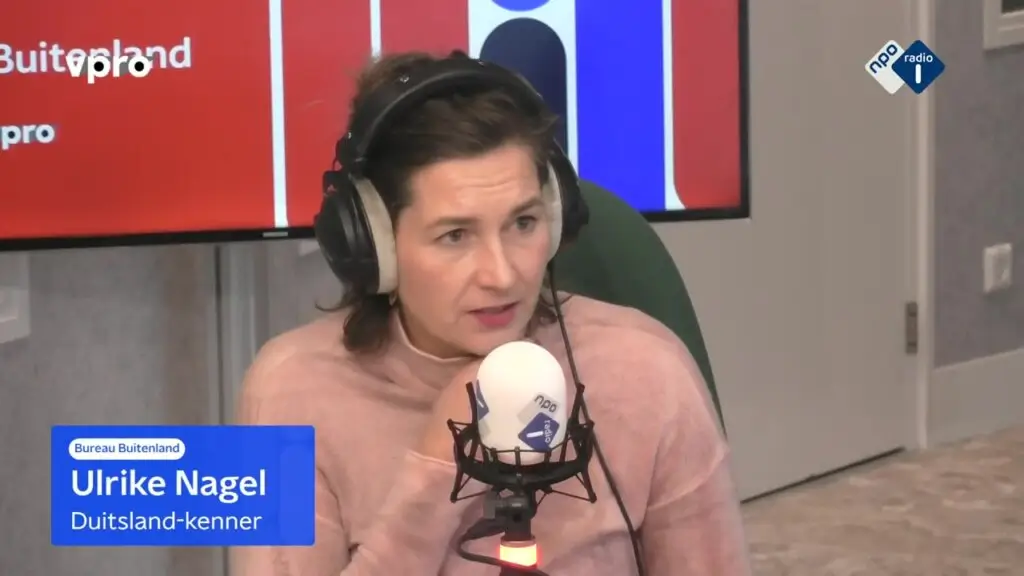
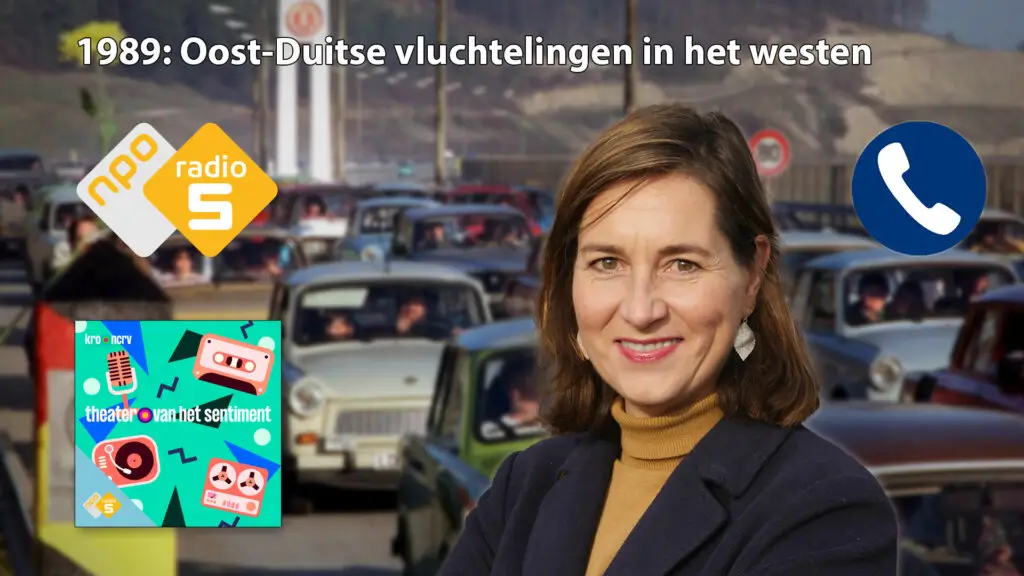
After the fall of the Berlin Wall, the Ostmark had to be exchanged for West German marks. As a result, bank vaults were suddenly filled with money that had become worthless. The money was dumped in an old mine. Years later, it turned out that some of the money had been stolen. The film *Zwei zu eins* is based on this true story. Germany expert Ulrike Nagel, who grew up behind the Wall herself, explains on *De Nieuws BV* how this came to be and why anyone would want to steal worthless money.
Summary
Summary
Introduction to the film ‘Zwei zu Eins’ [00:00] Tomorrow, the film ‘Zwei zu Eins’ opens in theaters. The film is set in 1990, shortly after the fall of the Berlin Wall. With the dissolution of the German Democratic Republic (GDR), the Ostmark had to be exchanged for West German marks [00:07]. Billions of worthless banknotes were left in bank vaults. The film tells the story of a group of friends who decide to steal that money [00:13].
Interview with Ulrike Nagel, an expert on Germany [00:49] Ulrike Nagel, who grew up behind the Berlin Wall herself, discusses the true story behind the film and why someone would steal worthless money [00:50]. She explains that the 1990s were a chaotic time [01:02]. As an 11-year-old in 1990, she didn’t notice much of the chaos; instead, she was mostly preoccupied with books and products at the supermarket [01:15]. Many new books became available, including American, British, and West German titles [01:31]. Nagel’s mother described the two years following the fall of the Wall as “total chaos,” during which people had to figure out how to transition from communism/socialism to a completely different system [02:00].
Introduction of the D-Mark and the “Kommt die D-Mark, bleiben wir hier” saying [02:31] In July 1990, the D-Mark was introduced in East Germany [02:31]. People were eager to get their hands on West German currency. There was a saying: “Kommt die D-Mark, bleiben wir hier, kommt sie nicht, gehen wir zu Ihr” [02:46], which means “If the Mark comes our way, we’ll stay here, but if it doesn’t, we’ll leave.” This happened frequently after 1989; many East Germans left for the West [02:56]. As a result, the West faced problems with overcrowded emergency shelters [03:07]. That’s why authorities wanted to ensure that East Germans stayed in their own country and kept their own currency, even though they wanted West German money [03:25].
The Monetary Union and the Ostmark [03:34] The transition from the Ostmark to the D-Mark was decided quickly [03:34]. Elections were already scheduled for March of that year, and everything moved much faster than expected, partly due to public pressure [03:39]. Many East Germans voted for Helmuth Kohl’s CDU, which wanted to reunify the countries as quickly as possible [03:55]. As a result, monetary union was also introduced quickly [04:12].
The “worthless” money and the looting [04:15] The bank vaults were filled with billions of worthless Ostmark bills. There were even considerations to bury the money [04:22]. The coins could still be used for another year, and for many people, the money held sentimental value [04:32]. However, the State Bank had no room for the new D-Mark, so the old money had to go [05:01]. After several auctions, 300 metric tons of money were stored in an old, abandoned mine near Hübbarstadt, which had been built by concentration camp prisoners during World War II [05:13]. It was believed that the money would be safe there and would rot away, since it was buried 60 meters deep and had only ventilation shafts [05:54].
The story in the film and reality [06:03] The film shows a group of friends entering the ventilation shafts in July 1990 to steal the money, at a time when it could still be exchanged for Deutschmarks. In reality, the mine was indeed broken into, but not until 10 years later, when the money could no longer be exchanged [06:37]. The film is “absurdist” and, according to Nagel, “not that great” [06:48]. It’s hard for Dutch people to understand because a lot of context is missing [06:56]. The thieves sell stolen goods to others for Deutschmarks, because West German sales representatives used to go door-to-door at the time to sell vacuum cleaners and microwaves, which East Germans really wanted [07:17].
The idealistic thieves [08:26] In the film, the thieves do not see themselves as criminals, but rather as seekers of justice [08:26]. They reason that the money belonged to the state, and in the GDR, everything that belonged to the state was “owned by the people” [08:34]. So if the State Bank and the money belong to the people, then in principle the money belongs to them as well [08:53]. They mobilize the entire apartment building where they live to join in [09:02]. According to Nagel, this idealistic East German way of thinking doesn’t quite align with reality [09:08]. In her view, East Germans were indeed extremely honest people, but also naive and easy to deceive, because they were unfamiliar with the market economy [09:16]. They had gained life experience in a different system, one with a planned economy and no profit motive [09:30]. That is why they decide to share everything they do with one another, and why they want to buy out a local business that is otherwise in danger of disappearing—a kind of socialism within capitalism [09:44].
Background
Background
Storyline
In the summer of 1990, when East German citizens are given only six days to exchange their Ostmarks for West German marks, childhood friends and lovers Maren, Robert, and Volker decide to steal a fortune in nearly worthless money from an underground bunker. Together with family, friends, and neighbors, they devise a creative plan to convert the money into valuable goods as quickly as possible and thus outsmart the capitalists.
With *Zwei zu eins*, director Natja Brunckhorst presents a lighthearted GDR comedy based on a true story. Featuring a star-studded German cast including Sandra Hüller (Anatomy of a Fall), Max Riemelt (Sense8), and Ronald Zehrfeld (Phoenix), it’s a story about love and loyalty, money and justice. The film evokes a nostalgic longing for the old GDR, mixed with the cheerfully chaotic madness of a world in transition.
Money from a Bunker
The new film *Zwei zu eins* is a romantic comedy set against the backdrop of a bizarre but true story. In 1990, after the fall of the Berlin Wall, the East German government was faced with a problem: what should be done with all that old paper currency, which had suddenly become worthless? Burning it was too expensive; shredding it too time-consuming. So they decided to simply store the bills—deep underground, in an abandoned factory in Halberstadt—in the hope that they would disintegrate on their own.
But things turned out differently. In the years that followed, a striking amount of East German money turned up in the area—including 200- and 500-mark bills, which had never officially been put into circulation. When the storage facility was inspected ten years later, it turned out the entrance had been broken into. And as for decay? Not a trace.
Director and screenwriter Natja Brunckhorst takes this mysterious story as her starting point and lets her imagination run wild. In *Zwei zu eins*, we follow three childhood friends from Halberstadt who are bored out of their minds and decide to investigate what lies behind the secret shipments to the old factory. What they discover: a hidden treasure trove of money—and a chance to turn their boring lives around. What follows is a lighthearted scam that involves the entire neighborhood, complete with clever tricks and loopholes in the law.