Journalist | Editor | Chairperson | Germany expert / correspondent | in Hilversum & Berlin
Radio 1: 80 Years After the War: How Germany Commemorates
2025 is not only an election year for Germany, but also marks the 80th anniversary of the end of World War II—a sensitive topic. How will Germany commemorate this event?
Joining us in the studio is Hanco Jurgens from the Germany Institute, and on the line we have journalist Ulrike Nagel, who grew up in East Germany and recently released a podcast on this topic: *Over the Wall*.
In this conversation
Journalist Ulrike Nagel and Hanko Jürgens from the Germany Institute discuss on the program “Met het oog op morgen” how Germany is approaching the commemoration of the 80th anniversary of the end of World War II in 2025.
Commemorative activities [00:35]: Hanko Jürgens notes that there are fewer commemorative activities than expected, but that May 8—the day of the unconditional surrender—takes center stage. In the GDR, this was celebrated as Liberation Day, but in the Federal Republic there was always debate over whether it was a day of defeat or victory over National Socialism.
East German Narrative [01:42]: Ulrike Nagel, who grew up in East Germany, explains that the narrative there was very different. The Soviet Union was seen as the liberator, and the other Allies played no role. Fascism was portrayed as the enemy of communism, which is why May 8 was celebrated as a victory. After the fall of the Wall, Nagel was exposed to the West German narrative, in which the Weimar Republic and all the Allies received more attention.
Sense of Guilt and the Revival of Debates [03:00]: The sense of guilt in Germany remains strong. It is striking that in recent years, World War II has actually seen a “revival” of debates, driven by a new generation. This is related to Germany’s position in the world, the war in Ukraine and Russia, and its complex relationship with Israel [03:34].
The AfD and the Guilt Complex [04:28]: The AfD (Alternative for Germany) is critical of the German “guilt complex” and has made statements that downplay the atrocities of National Socialism, such as Gauland calling National Socialism a “bird dropping” in the context of Germany’s long history [04:44], and Höcke, who demanded a “180-degree turnaround” in the culture of remembrance, while criticizing the Holocaust memorial [04:59].
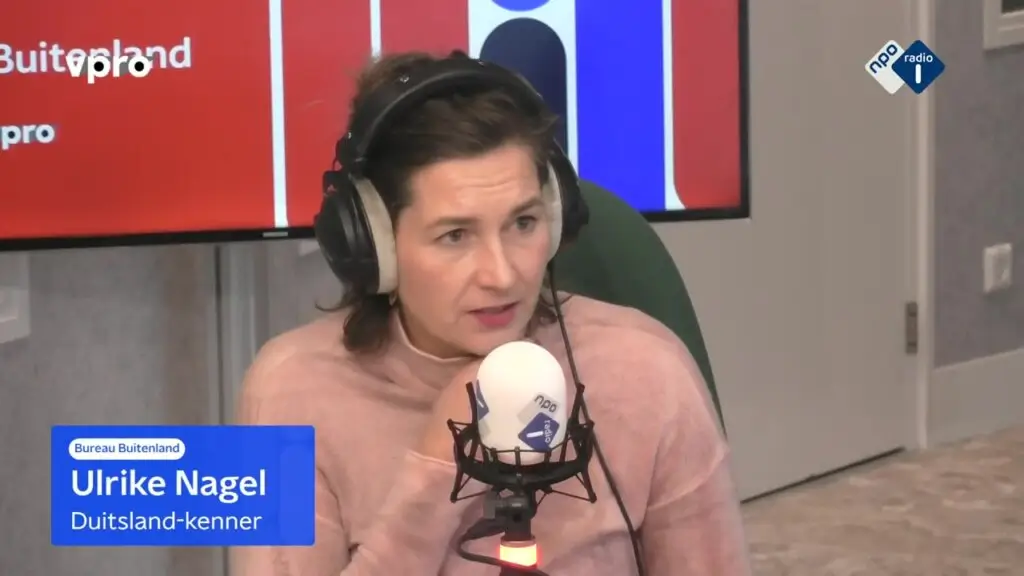
Ulrike Nagel speaks on Radio 1 about 80 years after the war: How Germany commemorates.
East Germans’ Relationship with Russia and Missed Opportunities [05:34]: Nagel emphasizes that East Germans have a different relationship with Russia, partly because their families fled from the Russians after the war, while the official narrative portrayed them as friends. Nagel regrets that the moderate parties have neglected Germans’ desire to take pride in their country and to commemorate their fallen relatives. This void is now being filled by extremist parties [07:02].
Victimhood and Coming to Terms [08:51]: Jürgens points to the 6 million murdered Jews as the central issue in West German commemorative culture. In East Germany, there was a stronger sense of victimhood stemming from the dictatorship, bombings, and captivity as prisoners of war, with less focus on the Holocaust. Nagel notes that East Germans are missing a part of that history and that there are still many unresolved elements, such as her own belated realization of the significance of D-Day [10:51].
Unfinished Unity [24:15]: Nagel concludes that Germany is officially unified, but that the differences between East and West are becoming clearer than ever, partly due to unresolved history and the frustrations that lead to more extreme voting behavior in the East.
At the end of the day, *Het Oog* provides an overview of the news, the morning newspapers, and journalistic interviews with people in and behind the news, all set to beautiful music. Each day of the week has its own host. The rock-solid format, combined with the hosts’ personalities and professionalism, has ensured that the program has been a unique radio show since 1976—one that is widely listened to and highly regarded.