Journalist | Editor | Chairperson | Germany expert / correspondent | in Hilversum & Berlin
On Radio 1: Major Flooding in Germany
For the second time in three years, Germany is grappling with major flooding. After relentless rain in Bavaria and Baden-Württemberg, several dams have burst, and villages in the region are being evacuated today. The damage is once again enormous. In Germany, the “Jahrhundertflut” of 2021—which struck the Eifel region just three years ago—is still fresh in people’s memories. And yet, once again, streets are flooded, dikes are breaking, and people are forced to leave their homes in search of higher ground. Is Germany sufficiently prepared for the growing threat of flooding caused by climate change? And what lessons have been learned from the catastrophic floods in the Ahr Valley in 2021? Our guest is journalist and Germany expert Ulrike Nagel.
00:00 Bureau Buitenland Tim de Wit 00:50 Ulrike Nagel
Summary of this discussion
Introduction to the Floods in Germany [00:01]: Germany is once again being hit by heavy rainfall in the south, leading to dangerous flooding. Several villages in the state of Bavaria have been evacuated, and there have even been fatalities. Journalist and Germany expert Ulrike Nagel discusses the situation [00:38].
The current situation and warnings
The latest news is that a 43-year-old woman was sadly found dead in her basement after she had been missing since Sunday [00:48]. Hundreds of people are being evacuated, and residents are strongly advised not to enter their basements, as it is very common in Germany—especially in that region—for homes to have basements [01:02]. People should move to higher ground inside their homes and gather important documents [01:18]. Three dams have burst near the village of Pfaffenhofen, and a noise barrier next to a highway has also collapsed, causing the highway to be flooded [01:33]. The fire department has been working nonstop for three days with tens of thousands of emergency responders. A firefighter died yesterday after falling out of a boat during a rescue operation [01:44]. Many people say they have never experienced water levels like this before [01:56].
Political Response
Chancellor Scholz visited the disaster area today [02:01]. It is not customary for the public to criticize the national government immediately; this usually happens a few days later [02:07]. Politicians appearing in rain boots is symbolic and a way to project their image [02:17]. Scholz noted that this is already the fourth time this year that he has had to go somewhere wearing rain boots in June [02:39]. However, the state premier, here in Bavaria, is the first to be addressed, since financial resources and regulations are managed at the state level [02:50].
Causes and Obstacles to Effective Measures
People are wondering why things are going so wrong again, given that promises were made to invest heavily following previous major floods [03:06].
Investments: [03:21] Although investments are being made (Bavaria has invested 4 billion euros over the past 20 years and plans to invest another 2 billion), the question remains as to who will bear the costs. Municipalities, the states, and the federal government (Bund) must reach an agreement on this [03:38].
Space for water: [03:59] A major problem is the available space for water. Unlike the Netherlands, where there are polders that can be flooded, there are few floodplains in Germany [04:01]. People have lived in areas along rivers for generations and are unwilling to give up their homes and land for polders [04:15]. Of the 10 planned floodplains, only three have been completed [04:30].
Climate change and political urgency: [04:39] Scholz cited climate change as the cause of the increasing floods. However, there are doubts about the sense of urgency in political circles [04:46]. There is a lot of talk and reports are being drafted, but implementation is slow, especially when it comes to funding [05:03]. Minister of Economy and Climate, Robert Habeck (Greens), is aware of this, but faces resistance within the coalition with the Liberal Party and the SPD, which hold differing positions [05:09]. The urgency is certainly felt, but implementation is difficult [05:34]. Habeck is also being criticized for his recommendations on energy conservation, and experts say the 2030 climate targets will not be met [05:39].
Impact on the European elections
The floods are currently dominating the news in Germany [06:06]. Images of politicians in rain boots could influence Thursday’s European elections, especially given that the current coalition is already struggling and trailing in the polls behind more extreme parties such as the AfD [06:18]. If the government takes accelerated action now to prevent these disasters, this could influence voters’ perceptions [06:48]. The Red Cross has warned that much more needs to be done to prevent disasters of this kind [06:53].
Forecast for the Coming Days
More rain is expected, and in some places, the water has not yet reached its peak [07:07]. The floodwaters are moving from Western Bavaria to Eastern Bavaria [07:16]. Most of the damage will only become apparent once the water has receded [07:24]. This was also the case in the Ahr Valley (Ahrweiler), where a large hotel only reopened three years after the disaster and the train station still hasn’t been fully repaired [07:27]. The aftermath of such disasters lasts for years [07:43].
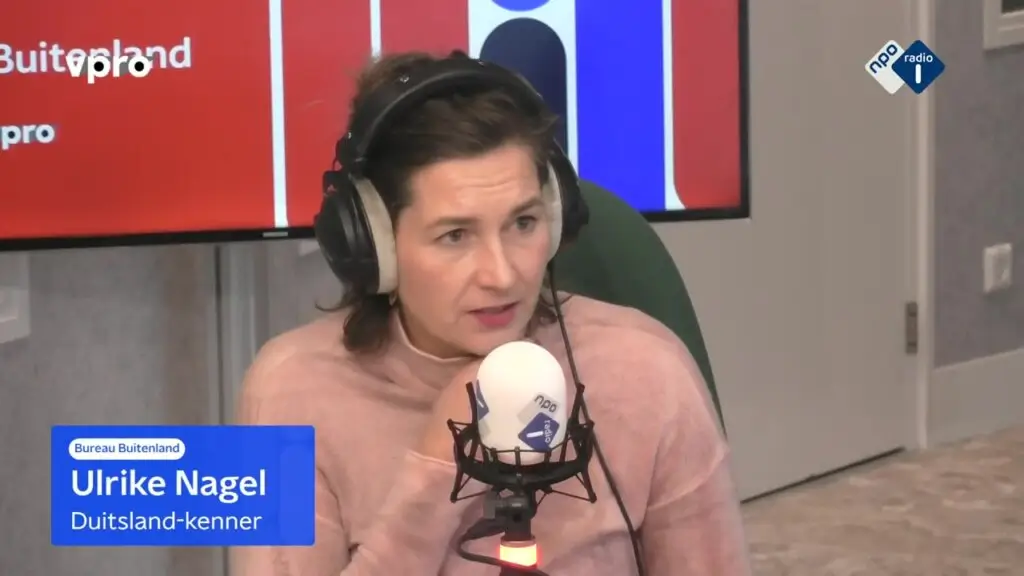
Ulrike Nagel joins Tim de Wit in the studio at Radio 1 to discuss the floods in Germany
Background
Two more people have died as a result of the flooding in southern Germany. The bodies of a man and a woman were found in a house in the German state of Baden-Württemberg. At least four people have died in total.
Emergency responders discovered the bodies while pumping out a basement in the German town of Schorndorf. The basement had filled with water due to the severe weather.
The victims were an 84-year-old woman and her 58-year-old son, who, according to witnesses, had been trying to pump out the basement. The exact circumstances remain unclear.
Earlier, emergency responders had already found the body of a 43-year-old woman in the town of Schrobenhausen, north of Munich. On Saturday evening, a 42-year-old firefighter died while trying to rescue a family from a bungalow in Pfaffenhofen. In that town, a dam on the Paar River burst on Sunday.
The death toll may rise further. For example, a 22-year-old firefighter is missing in Bavaria. His boat capsized. The search for the man had to be suspended due to high water levels and strong currents.
Water Breaks Through Roadside Noise Barrier in Germany
German Weather Service Issues New Warnings for Severe Thunderstorms and Rain
Water levels in various rivers and streams in the states of Bavaria and Baden-Württemberg are extremely high following last weekend’s heavy rainfall. The situation deteriorated in many areas overnight from Sunday to Monday.
The German weather service has also issued a new warning for severe thunderstorms with heavy rainfall on Monday. This applies primarily to the south and east of the country.
Bavarian Prime Minister Markus Söder also expects the flooding to continue through Wednesday or Thursday. Even once the rain stops, the high water levels will remain dangerous for some time, Söder emphasized.
Due to the weather, hundreds of residents who were at risk of being cut off by the water have been evacuated. Several dams have burst as a result of the rain. In addition, local power outages are occurring due to the flooding.
German Chancellor Olaf Scholz visited the affected town of Reichertshofen in Bavaria on Monday. Scholz said that the flooding is not an isolated incident. “We must not neglect the task of halting human-caused climate change,” he said. According to the chancellor, the floods are a clear warning.
Climate advisors to the German government warned on Monday that Germany does not appear to be on track to meet its own climate targets for 2030.
On “Bureau Buitenland,” you’ll hear international news, reports, and geopolitical analysis. Featuring background information and noteworthy stories, Monday through Friday from 1:30 to 2:00 p.m. Hosts: Sophie Derkzen and Tim de Wit