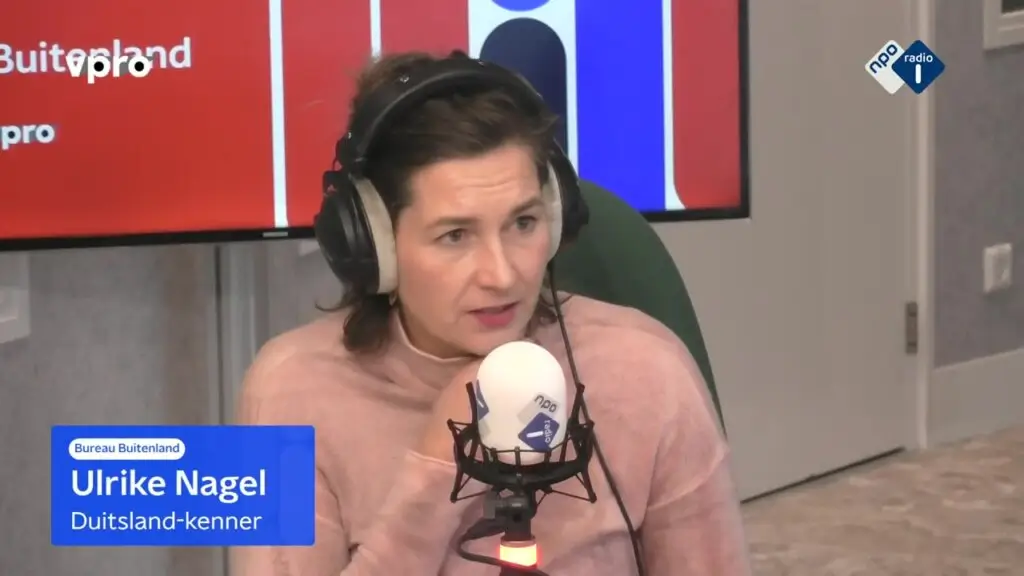
Listen to the report by Judith van de Hulsbeek featuring Ulrike Nagel.
Summary of the conversation ↴
The transcript is from a radio report by correspondent Judith van de Hulsbeek in honor of the 30th anniversary of the fall of the Wall and the end of the GDR. The report focuses on daily life under the socialist dictatorship, which, according to an exhibition in Berlin, “wasn’t all misery.”
Van de Hulsbeek visits the exhibition with two Berlin “Ossies” (East Germans): Ulrike Nagel and her mother Susanne Nagel.
Life in East Berlin
- Home and Work: Susanne and Ulrike lived in the new housing development of Ahrensfelde, a typical “plattenbau” (concrete panel apartment buildings). Susanne worked near the Brandenburg Gate and had a view of a border checkpoint.
- The Wall: For Susanne, the Wall was a constant presence and a fact of her entire life, but not something she thought about every day. They didn’t approve of it, but didn’t take action because she wasn’t a “political person” and the oppression and resistance took place mostly underground.
- Childhood: Ulrike, who speaks Dutch fluently, was ten when the Wall fell. She remembers a safe childhood in which she roamed the city with friends, often by tram (Straßenbahn). Since everyone worked, parents were rarely around, giving the children a great deal of freedom.
Recognition and Nostalgia
- Exhibition: The exhibition is a feast of recognition, featuring images of cars like the Wartburg, Lada, and Trabant, as well as typical East German objects.
- Propaganda: They see footage from a news broadcast from the late 1980s about the parade on International Workers’ Day (May 1) on Karl Marx Allee. Ulrike recalls that she thought it was “great” and was a “go-getter” who got excellent grades in school for “good socialist learning” (exemplary socialist citizen).
- Between the lines: Susanne notes that the media was full of “empty chatter” and you always had to read “between the lines” to know what was really going on.
- Cheerfulness: Despite everything, Susanne says there was also a lot of cheerfulness and fun. She claims that 80% of the GDR population was just as cheerful as people in the West.
The Consequences of Reunification
- Takeover: Susanne finds it unfortunate that after the fall of the Wall, everything associated with the GDR had to disappear. They wanted the “Western money” (the financial opportunities), but had to take over everything immediately.
- Frustration: People who were proud of keeping the country running found themselves unemployed overnight and left to fend for themselves. Susanne concludes that it’s no wonder many East Germans are angry and frustrated (which she briefly links to “voting for the right”).
Background
The exhibition visited is: Special Exhibition: East Berlin. The Half Capital.
Date: May 2019 – November 10, 2019
Location: Ephraim Palace, Berlin
East Berlin had many faces: the metropolis was the power center of the SED and the showcase of the GDR. At the same time, it offered space for different lifestyles and a diverse culture. How did these contradictions influence people’s daily lives, and what experiences were associated with them?
The exhibition at the Ephraim-Palais museum takes you on a journey of discovery from the late 1960s to reunification in 1990. Fascinating original objects, photographic testimonies, and film and audio documents illustrate urban life—from urban planning and housing to work and leisure, fashion, and consumption. In this way, a vanished city comes back to life, traces of which can still be found in present-day Berlin. In addition, interested individuals from both East and West can present their own objects in the exhibition under the motto “Mein Ost-Berlin” (My East Berlin) and describe their experiences with the city. Berlin students and school classes will accompany the historical city tour with their own projects.
A varied program featuring guided tours, lectures, workshops, a film series, discussions, and a major retrospective accompanies the exhibition. And that’s not all: in collaboration with Berlin’s district museums, East Berlin is being brought to life throughout the city.
Every morning between 6:00 a.m. and 9:30 a.m.: the NOS Radio 1 News. The broadcasts cover the latest news, background stories, reactions, analyses, and sports.