Journalist | Editor | Chairperson | Germany expert / correspondent | in Hilversum & Berlin
RBB Brandenburg News: Working from Home, Kids at Home
It has been two weeks since Brandenburg was forced to close daycare centers and schools due to high COVID-19 infection rates. Starting this week, emergency child care has been expanded to include children whose parents have only one parent working in the health care or nursing sectors. But as we’ve learned, anyone who isn’t “essential” has to fend for themselves. Suddenly, this is once again the parents’ responsibility. Our reporter Ulrike Nagel offers insights into the turbulent daily life of families.
A report by Ulrike Nagel for RBB Brandenburg Aktuell.
Since March 2020, our economy has been undergoing a transformation of unprecedented scale. Not only have stores, restaurants, and bars had to close, but so have schools and daycare centers. Millions were placed on short-time work or forced to work from home. Working from home was the order of the day. Because schools are closed, parents now have to step in during the COVID-19 crisis. This is also changing daily life for families. Very few companies and employees, however, were truly prepared for this. Schools, which were now expected to implement homeschooling, fared not much differently.
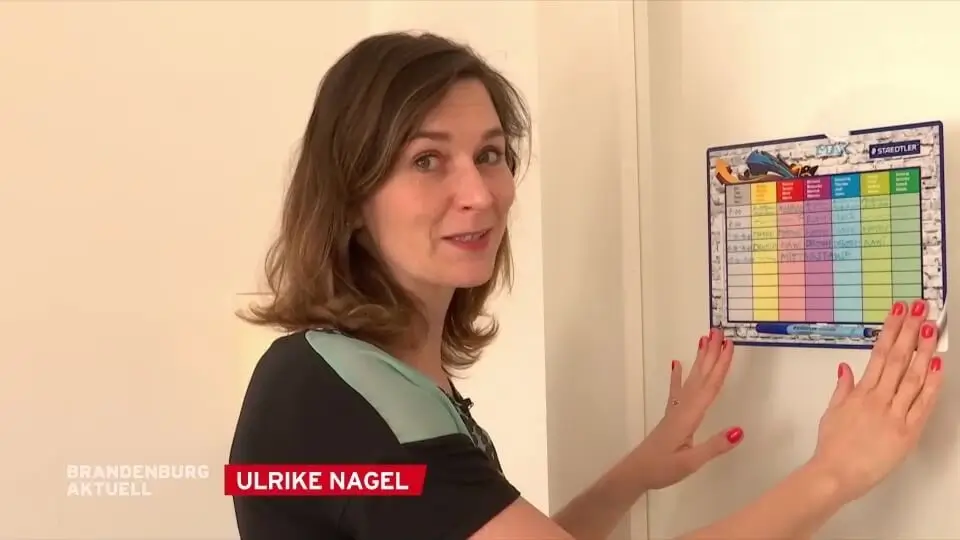
Ulrike Nagel in the RBB Brandenburg Aktuell segment, “Children at Home”
Homeschooling is a form of education and upbringing in which children are taught at home or in other locations outside of a school by their parents or private tutors. Since Germany has compulsory school attendance rather than a general obligation to receive an education, and since this requirement—unlike, for example, the Austrian obligation to attend classes—is tied to school attendance (compulsory schooling, mandatory school attendance), children may only be exempted from attending school and receive homeschooling in exceptional cases.
In Germany, so-called homeschooling has been prohibited until now. However, during the COVID-19 crisis, parents have suddenly had to take charge of their children’s daily learning themselves….
Summary
This article addresses the challenges of working from home while also caring for young children and supervising school-age children at home, particularly during the period when daycare centers and schools in Brandenburg are closed.
Reporter Ulrike Nagel describes the turbulent daily family life with her children. She reports that the attempt to create a structured schedule has become nearly impossible to maintain after two weeks. The daily routine constantly deviates from the plan.
Her school-age children, Max (6th grade) and Lotta (3rd grade), receive their assignments for subjects like German, math, and English partly through a website where the teacher can also check their progress. Both children share their thoughts:
Max thinks school is more fun because he can play with friends there, which isn’t allowed at home right now.
Lotta thinks it’s annoying that she isn’t allowed to play, but she likes that she gets assignments.
Their mother is trying to get her own work done (translating a book), but she’s interrupted every few seconds. Working from home, she’s simultaneously a teacher, a supervisor, an explainer, a cook, a mediator, a cleaner, and a translator. She has to master this constant role-switching.
Despite the challenges, they try to stay relaxed and go out for some fresh air. At the end, the reporter jokingly apologizes that some assignments might be missing in a few weeks and leaves it open as to whether she’ll be able to finish her own work.
Ulrike Nagel’s report for RBB Brandenburg Aktuell, “Kids at Home”