Journalist | Editor | Chairperson | Germany expert / correspondent | in Hilversum & Berlin
Ulrike on “Tijd voor Max” – About Angela Merkel and Her Book
Germany expert Ulrike Nagel discusses the book containing the political memoirs of Angela Merkel, the former German chancellor who held that office for 16 years.
Introduction ↴
Angela Merkel served as Chancellor of Germany for many years. Through her actions and her demeanor, she left her mark on German, European, and international politics. In her new book, *Freedom*, she looks back on her life in two German states: in the GDR until 1990, and subsequently in reunified Germany. How did she, as an East German, manage to become the first female chancellor of a unified Germany and one of the most powerful heads of government in the Western world? What drove her?
Summary of the conversation ↴
Introduction Today, the book *Freedom*, Angela Merkel’s long-awaited political memoirs, was published simultaneously in more than 30 countries. In this book, the former chancellor looks back on her life, the first 35 years of which she spent in the GDR and the next 35 in reunified Germany [00:25]. Ulrike Nagel, a Germany expert, grew up in the GDR just like Merkel [00:37].
A glimpse into Merkel’s private life [00:40] Nagel explains that Merkel rarely opened up during her career [00:40]. However, the book does offer a better glimpse into her private life, especially in the first chapters about her childhood [01:04]. The 730-page book was not sent to journalists in advance, indicating that Merkel wanted to maintain control [01:04]. She has rarely spoken about her childhood in the GDR, so it’s interesting to read more about it now [01:21].
Merkel’s Strengths and Challenges [01:38] Merkel’s greatest strength was her ability to survive in politics for 16 years—not because no one wanted her, but because she herself felt it had been enough [01:38]. She had to hold her ground in a divided Germany and later in a “massive macho male-dominated culture” [01:51]. As a member of the CDU, a party she eventually took over, she found herself among traditional West German men with big egos [02:05]. She was often thwarted and quickly learned that, as a woman in that context, she had to set her emotions aside [02:23]. She never emphasized her femininity or her East German background, but modestly put her personality in the background for the “greater good” [02:42].
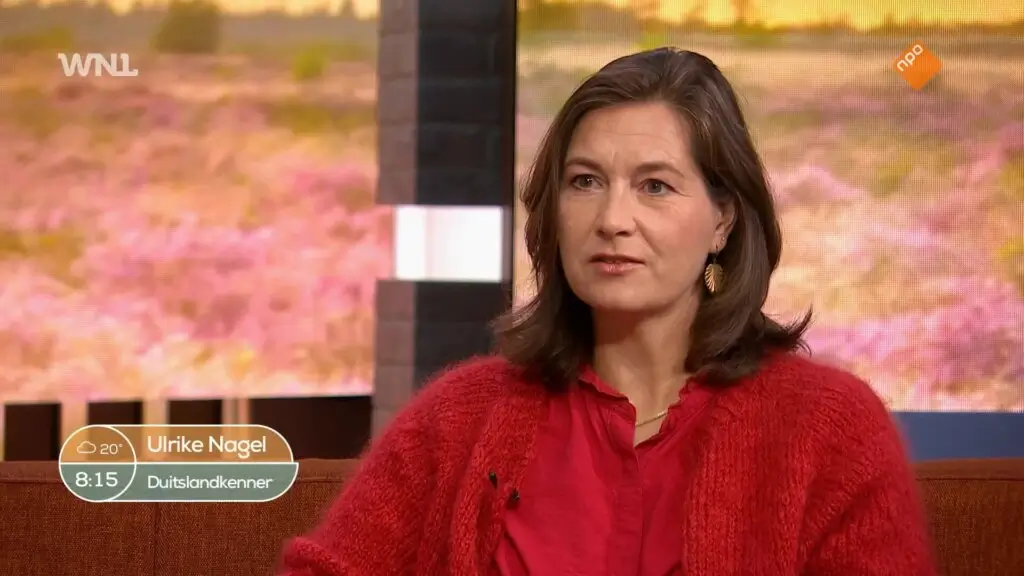
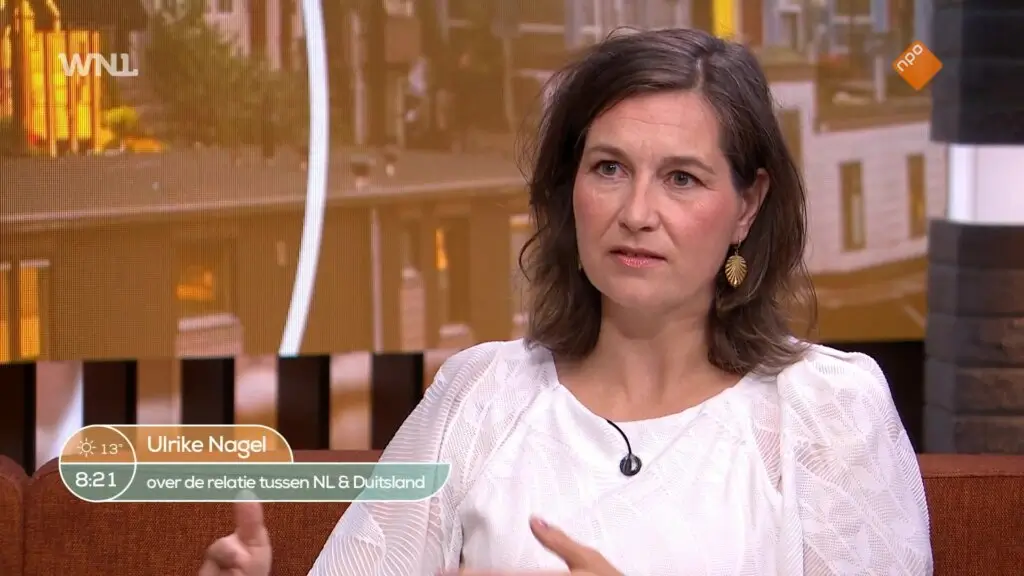
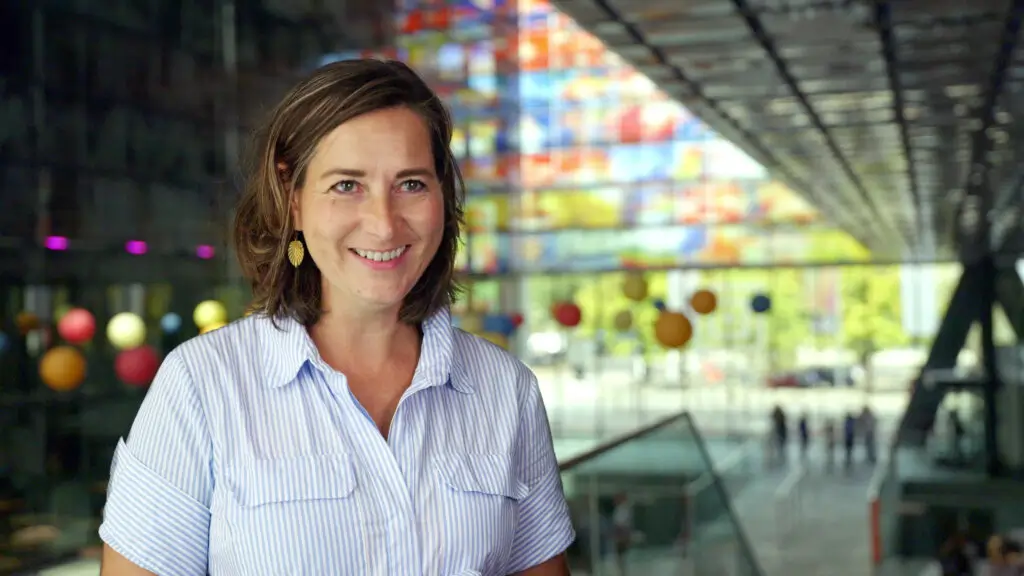
Ulrike Nagel in the studio of *Tijd voor Max*
Merkel’s childhood in the GDR and parallels with Nagel [02:59] Merkel describes her childhood in East Germany as “happy” [02:59]. Nagel, who has produced her own podcast about her childhood in the GDR, notes that Merkel is 25 years older and experienced the fall of the Wall as an adult, while Nagel was a child [03:04]. As a child, the GDR was a “protected, safe world” with plenty of freedom for children [03:24]. Merkel grew up in the countryside, although she was born in Hamburg (West Germany) [03:34]. Her father, a pastor with political connections, moved the family to the outskirts of Berlin [03:38]. She received an intellectual upbringing from intelligent parents; her mother was a teacher, and her father was a pastor and highly educated [03:55]. Merkel studied physics and had to “navigate” the system, being careful about what she said [04:08]. She found the socialist courses she was required to take a “thorn in her side” and avoided open criticism so as not to jeopardize her career [04:39]. “Living On The Edge” or “leben an der Kante” (pushing the boundaries) was an art she mastered [05:13].
The Fall of the Wall and Her Political Career [05:23] Merkel was overjoyed at the fall of the Wall in 1989, because the constant need to navigate carefully and watch what she said took a lot of energy [05:23]. She was happy about the new opportunities to travel and pursue other academic endeavors [05:40]. She soon entered politics because she wanted to be part of something new [05:49]. Although she crossed the border and returned on the very first night of the Wall’s fall, she was surprised that in the days that followed, the conversation was all about politics [05:59]. She was a supporter of reunification and therefore entered politics [06:09].
Influence of Her GDR Background and Criticism of Merkel [06:16] Her GDR background has influenced her political career, especially her ability to “navigate” [06:16]. She rarely spoke about her personal background, which makes the book interesting [06:22]. She remained modest amid “egotistical men” [06:47]. Although Horst Seehofer once accused her of being power-hungry, Nagel finds this implausible, because Merkel always prioritized the “greater good” and what was best for the country and the world [06:55]. She wasn’t vain, and she was always focused on the substance [07:24]. Toward the end of her chancellorship, she faced a lot of criticism for her indecision and slow decision-making [07:47]. However, she has no regrets and believed she acted correctly based on the information available at the time [08:02].
The “Wir schaffen das” and the refugee crisis [08:21] Her statement “Wir schaffen das” (we can do this) is often held against her [08:21]. She herself says she said this because, if people could tear down the Berlin Wall, they could also handle a wave of refugees [08:27]. This was one of the few times she spoke from her deepest convictions and values [08:38]. The fact that this “somewhat emotional remark” is held against her so heavily proves, in hindsight, that she was right to always set her emotions aside [08:51]. She wondered what else she should have said: “Should we have said, ‘We won’t make it’?” [09:03]. She adhered to existing laws designed to help people in need [09:07]. Her family history—in which her grandmother lived through World War II and the bombings and was forced to flee—likely played a role in this [09:13]. This demonstrates that Germans themselves have also experienced millions of refugees [09:36].
Distance from the People and International Politics [09:55] Merkel had little “connection” with the people [09:55]. The hierarchy between politicians and citizens is much greater in Germany than in the Netherlands, and Merkel was not a “people person” like Rutte [10:18]. Her greatest strength lay not in her ease in interacting with people, but in her steadfastness [10:28].
Meeting with Putin and dogs [10:41] Things weren’t made easy for her in international politics either [10:38]. A well-known example is her meeting with Putin, during which Putin threw a dog at her feet [10:41]. Merkel was terrified of dogs, and Putin knew this [10:50]. Nagel thinks it’s impressive how Merkel handled this, because she didn’t react immediately but still responded by saying it was a deliberate provocation [11:02].
Ulrike Nagel in the studio of “Tijd voor Max”Background ↴
In *Freedom*, Angela Merkel describes daily life in the chancellery, as well as the highly dramatic days and nights when she had to make high-stakes decisions in Berlin, Brussels, and elsewhere. She outlines how international cooperation has changed over the years and the pressure politicians face today in seeking solutions to complex problems in a globalized world. She takes us behind the scenes of international politics and shows the significance of personal conversations—and their limitations.
Guests: Gertjan Verbeek, Teus Lebbing, Ulrike Nagel, Karin Bloemen.
In 700 pages, Merkel describes her childhood in the GDR, her rise in politics, and the numerous decisions she has made. Political circles in Berlin have been eagerly awaiting the book’s release for months, particularly the section on the latter. The book makes it clear that Merkel stands by all her decisions. From Nord Stream to “wir schaffen das,” from the euro crisis to the Ukraine crisis: Merkel defends her political legacy and expresses no explicit regrets—with the exception of a single decision made during the COVID-19 crisis.
Angela Merkel’s book *Freiheit*
For example, the CDU politician defends her stance toward Russia, with which she sought to build a good relationship. Merkel writes that she understands Eastern European countries that did not want to invest in better ties with Russia, but “they seemed to wish that the country would simply disappear. But Russia, with its nuclear weapons, existed. It was and is geopolitically indispensable.”
Merkel also defends her blocking of Ukraine’s and Georgia’s rapid NATO accession in 2008, citing the possibility of a military response from Russia. That decision has drawn criticism following Russia’s invasion of Ukraine, but Merkel remains steadfast in her support of it. In this regard, the former chancellor also emphasizes her own country’s security interests. “A new member must not only bring security to that country, but also to NATO itself.”
She also continues to support the construction of the controversial Nord Stream gas pipelines. “After the Russian invasion of Ukraine, I was accused more strongly than ever before of having made Germany irresponsibly dependent on Russian gas,” she writes, going on to explain that alternatives were more expensive and that Germany actually wanted to phase out nuclear energy. She also writes that countries like Poland and Ukraine would not necessarily have opposed Russian gas if the pipelines had run through their territory.
Merkel is most explicit about the title of her book, *Freedom*, in the epilogue. She attempts to redefine the meaning of the concept: “True freedom is not solely focused on one’s own advantage; it is guided by restraint and scruples. True freedom is not merely freedom from something—from dictatorship and injustice—but is manifested in responsibility toward something: toward our fellow human beings, toward society, toward our community.”
“Tijd voor MAX” is a live television program produced by Omroep MAX. The program is hosted by Martine van Os and Sybrand Niessen. The program airs every weekday from 5:10 p.m. to 5:55 p.m. on NPO 1. “Tijd voor MAX” covers various topics such as health and prevention, consumer affairs, lifestyle, and current social issues. Every day, a (well-known) guest of the day joins the show to discuss these topics.